Who is the Boogieman?

While many may feel big government is the boogieman threatening to take away our freedoms, I worry that big business is the greater threat. Their money makes for a loud voice, and when they decide to buy speech, little seems to stop them.  Unlike a government which is bound by borders, they are international citizens purchasing and often dictating policies throughout the world.  They speak to an international crowd.  Their voices drown out reason.  Their products seduce us in to acceptance or denial.  They become our masters.

Okay, I really don’t think capitalistic doom awaits us around the corner, but it cannot be denied how corporate influence is at the heart of many of the economic ills plaguing us today.  It makes me wonder, how many of the attacks on the US government, or other national governments, are being paid for by corporations who love deflecting attention from their own role in our economic woes?

Accountability should be shared, but in a world where speech can be purchased by the highest bidder, it is far easier to buy out the market, to sell a pretty package, or promise a miraculous future rather than to acknowledge responsibility for risky mistakes and ventures.

While governments must try to care for their people, corporations are not bound by the same constraints.  It is easy to find examples of harmful or wasteful products being sold to the masses.  The boogieman is artful in his disguise and sells an enticing product, but beneath all the glamour, sparkle, and loud noise, the big business is focused only on one thing – profit.  People become expendable resources on a spreadsheet of greed.

These ponderings I share have been meandering through my brain for a while, but an article concerning Olympic marketing brought them to the forefront today. While much attention is directed at “draconian” governmental control, the underlying boogieman is the corporate sponsors who do not want even grandma to stitch the Olympic rings on a sweater, or junior to wear a competitor’s t-shirt.

Maybe this is why corporations are considered people by so many wealthy leaders.  If the corporations are not people, then governments no longer can say they serve the people.

So who is the boogieman, and who is stirring up the pitchfork wielding crowd? I will let you decide, for now I must return to playing with my techie toys, and eating my yummy junk food all while I get ready to watch the Olympics this weekend.
A Gun Owner on the Subject of Guns

It is said all the time here in the US that “guns don’t kill people, people kill people.”  In light of the latest horrible episode depicting the horror wrought by one human on another, the saying should be changed.

“Guns may not kill people, but people carrying guns kill people.”
More people carrying guns will only lead to more dead, not less.  

People legally carrying guns into schools, parks, and theaters will not deter the senseless, horrific killings of innocents.  By all means, if you chose to own guns, do so, but do so at home, or on the gun range. Do so after receiving training. Do so with the knowledge that only nutcases talk about killing others.  Spouting off that you are prepared to kill another, even in self-defense, does not make you sound brave. It makes you sound foolish.

Many men and women train to protect the nation and its citizens with deadly force if needed, but I doubt they brag about the actual idea of killing another human being.  It is one thing to own a gun in honor of your Freedom to do so, it is completely different to own a gun with the intent to kill someone.  If you doubt this, ask a cop or a soldier.

My thoughts and prayers go out to all those who have lost their lives or their loved ones this week.  My heart aches for your sorrow.

Why Do We Go to War?

A friend of mine posed a question as to when war is justified on her Facebook wall.  The discussion that followed became focused on why those who have experienced the horror of war would ever justify the value of another war.  This is my take…

Human beings tend to enjoy being in groups.  Like with cows, the majority will stay with or nearby the herd.  Some will go rogue, wander away from the heard and chart a separate course, but most will stick to the herd.  Herd mentality dominates our social, political and economic lives.  A family unit is a herd, a political party is a herd, and school is certainly herd like.

Where human nature deviates from the cow nature is in the ability to reason.  Pecking order behavior, i.e. strong vs. weak and experienced vs. youthful, will still impact the human herd, but the human herd will reason or justify their actions and choices.

When confronted with enough data, evidence, propaganda or rhetoric, the human herd will justify a course of action.  They will justify a course of action in order to remain in the herd.  If they remain unconvinced that the course is justified, they may seek to separate from the herd, but will look for another herd to join.  The theory that there is safety in a crowd certainly applies to ideological fears of danger as well as physical fears of danger.

War is simply one of many courses mankind justifies. In contrast to peace, war is much easier to propagandize.  Fiery speeches, enflamed rhetoric, and poignant sound bites are easy to develop when fear and danger is in the mix.  The key to a successful herd is in maintaining a feeling of security in the group.  Threaten the group and it will rally together in defense.

So why do people who have experienced war agree to additional war?  Simply put, even the horrors of war cannot negate the justification of protecting the herd.  Although there are some who will develop such a strong sense of revulsion to conflict that they will suppress any feelings of self-preservation in order to avoid further conflict, they are rare and seldom include mothers.

A final point, no two people ever experience war with the same perception.  Even those participating in the same horror, experience the horror differently. This makes me think, strangely, of childbirth.  Why would anyone who nearly died in the delivery room ever seek another pregnancy?  The justifications of the blessings override the worry of fear, pain, and possibly death.  In the case of war, if the end result can be portrayed as being of greater value than the known casualties associated with war, then the herd can be persuaded to follow a course of war.

To Be Informed or To Be Educated

The citizens of the United States are distracted by political campaign information. They are embroiled in heated debate over healthcare. They argue about getting rid of the immigrants who long to support our economic and social system when they should be concentrating focus on the dangerous criminals who are the real threat. Therefore, they are missing the warning signs of other problems on the horizon.  One such international problem can be found just across the southern border as Mexicans go to their polls.

It is doubtful the President or the experienced members of congress are distracted from the international problems. Looking outside of the US, one sees that the US is not the only nation struggling with a poor economy, immigration issues, international crime and terrorism. What kind of a future does the US face, if a majority the ‘experienced’ leaders in DC are replaced by a whole new crew of 1st timers? Especially if the only agenda they bring with them is on the US economy, and on the US healthcare, and on the US borders.

The origins of US immigration policies are found in the early 1900’s during the time when isolationism was still being valued as good US policy. Isolationist policies, however, did not prove effective in the early 1900’s, they simply made the US late-comers for two wars for which joining was unavoidable.  In 1942 the internment policy of rounding up anyone “suspicious” was beyond contemptible, but it was policy.  Fear and a tremendous feeling of suffering dictated US domestic and foreign policies in the first half of the 20th century.

However at the same time the US was closing its borders, there was a social push to help its poor and downtrodden citizens.  Labor laws, workers unions, Social Security and legislation similar to the National School Lunch Act, all played a role in post war successes.  Due to economic policies during WWII, employer based health insurance became widely offered as well.   It was determined that prosperity was much easier to achieve if the nation was healthy rather than unhealthy. There was a need for the government to act, and the power of big government began to replace the power of big business.

Now a hundred years later, immigration and health care issues are at the center of US politics again.  Citizens are beginning to fear “others” and focusing on national issues while avoiding international issues.

Progress has been made but fear, misinformation, and “money” backed political theater will not keep the progress moving forward.  Talk of the “good ol’ days” is just talk.  If you are blessed to know survivors of those days, ask them about epidemics, outhouses, food shortages and social inequality.  It is a human trait to reminisce of the ol’ days. Selective memory is common, some prefer focusing on the good and some on the bad.  The citizens of the United States need to evaluate the good and the bad, the effective and the ineffective.

It is sad that with easy access to so much information, so many are misinformed.  A random comment posted concerning an editorial on the Supreme Court Healthcare ruling claimed, “We are becoming like the USSR.”  Many would like to blame this misinformed opinion on a failing educational system, but that would be unfair.  That would be like saying Fox News, or CNN, or MSNBC are to blame for all the ignorance in society. To quote a common saying, “guns don’t kill people, people kill people”, on that same reasoning, “cable news doesn’t make ignorance, people choose ignorance”.

Ignorance is conquered when an individual seeks information, evaluates the information by comparing it to other information, and then forms an opinion. This is how an individual becomes educated.  This how parents should be teaching their children. This is what voters should be doing before casting a vote.  This is what politicians should encourage.

While some journalists still prescribe to providing information rather than opinion, it is not up to them to educate us.  It is up to the individual to become educated and not simply informed.

Do we still justify injustice?

The practice of eugenics is a scar on our nation’s character.  This scarring should be a warning to us of how easy it is for “good intentions” to go too far. During a war, some may feel the good of the whole outweighs the good of a few, but this is seldom justified during civilized peacetime.  Providing for the general welfare of a population may infringe on the monetary rights of the citizens, but should not infringe on the human rights of the citizens.  The practice of eugenics crossed this ethical line.

For the most part, I agree with the philosophy that money does not undo injustice, as North Carolina’s Senate determined this week in regards to monetarily compensating the victims of forced sterilization. When injustice is isolated, a few are victimized and should be compensated.  When the injustice is widespread, we are all the victims and there is no compensation equal to the harm which was done.

As a society we tend to turn away from how injustice has been part of our nation’s “modern” past.  In doing so, it is easier for us to ignore injustices still in practice.  When the ideology of one group, no matter how large the group may be, infringes on the rights of others, we are in danger of ignoring the lessons of the past and we may try to justify the unjust.

It is through remembering the past that we become empowered to work for a better future.

Target Marketing

Remember back thirty or so years ago when being chosen to participate in a TV survey was an honor?  You were a Nielsen family and your TV preferences counted. Your voice mattered.

With cable and satellite, the idea of being a survey family has fallen out of favor.  I am not even sure my kids know what a Nielsen family is, but if they did, they would probably think it was redundant.  Don’t the cable/satellite companies track everything we watch as it is?

In the past, my husband was a huge fan of radio surveys, at least until he started using an IPod.  I am unclear whether ITunes collects data, especially as we seldom log in, but I am sure Pandora is collecting information from my husband.

It seems the novelty of being part of a survey has worn off as technology now makes so much more available to companies seeking information about consumers.  I remember, in years past, getting phone calls asking me what kind of laundry detergent I preferred, or what kind of shampoo I used.  Sometimes those calls were a nice respite from motherhood; sometimes they were simply odd since I wasn’t much of a brand name shopper.  Either way, I never felt my privacy was being infringed in any way.  I still don’t feel my preference of soap is intrusive information.

Just recently, while planning for a trip, I searched online for “support” socks.  It is amazing how quickly and abundantly ads for support socks showed up on Facebook and Amazon since my search and purchase.  These adds do not bother me, it is needing the support socks when traveling which bothers me.

Media discussion about target marketing seems plentiful, and while I agree there are some negatives, from a personal standpoint I don’t find this type of marketing to be much of a problem.  It is actually less irritating than the huge piles of junk mail of the past.

Another advantage with target marketing is that unlike TV commercials, I don’t get hounded by ads which I find objectionable.  Out of curiosity the other day, I tried to delete an ad from my Facebook page. I was delighted when I could.  I am not sure it is always possible, but in this case I could not only delete the ad, but also give feedback as to why I wanted it removed.

Target marketing is nothing new; the method of information gathering is all that has changed.  As with any other change, learning how to maneuver in a less than private world takes some adjustment before a comfort level can be reached.  Some days I feel frustrated with all the disruption to my comfortable rut, but on other days, I reflect on how this constant change is keeping my brain active.  It is up to me to look at the negative or at the positive of the changing world.

Now I ponder – would it have been funny or mortifying if on the day I searched for “support” socks, I had also searched for a sexy negligee?  Since it was a family trip I was planning, the thought and the search never occurred.  Give me another decade…

Censorship or Good Neighbor

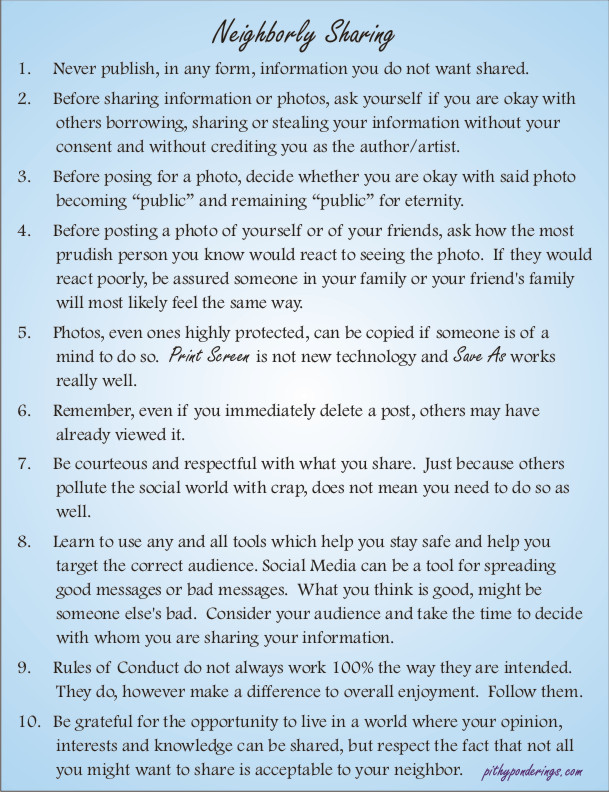
Is it censorship or a violation to constitutional rights when a privately owned company providing a service chooses to set decency policies?  In a recent Facebook debate, I read a multitude of criticism over Facebook deleting a photo some deemed objectionable and others deemed humorous.   The following are some questions that came to my mind.

  1. When does a privately owned company providing a service become so big that it is perceived as “public” space rather than a service?
  2. Why is an attempt to protect civility or decency perceived as a civil rights infringement to so many?
  3. When did the public come to conclusion it is a smart idea to save original data, photos or conversations on a server they do not personally own?

I have become a huge fan of using technology and social media to communicate with distant acquaintances and friends.  I have found social media to be an enjoyable way to connect, but I always utilize the advice of my mother, my journalism instructors and my own common sense.

Accountability

I have already written about the problem of entitlement and how society tends misplace the blame for this societal ill.  This is not the only area in which society is misplacing blame and avoiding individual accountability.

While reading an article today on the recession, and perusing the comments made in response, I once again was amazed at how accountability is sorely lacking in our society.  For the record, I believe that the role of the government is to safeguard the people, and understand that while regulations sometimes restrict economic progress, they can also aid in safeguarding the people.  With that being said, when I hear assertions that the recession is the fault of our most recent presidents, or Wall Street, I get a bit miffed.  Yes, Wall Street should be held accountable for their greedy actions and our government should have been more diligent in its oversight, but when are we the individuals going to accept the unpopular accountability for our own choices and actions?

When I read about how more young people need to live at home because they can’t afford their own place, or of the difficulties associated with buying or keeping a home, I wonder why we blame the government.  How is it that we can argue over government enforced healthcare, claim the government is interfering in our lives, yet at the same time cry foul that the government hasn’t helped us find a job or buy a home?

Don’t get me wrong, I feel for the people of our nation. This recession has hit us all in ways we did not foresee, but foreseen or not, we should have been better prepared.  Like any good Boy Scout will tell you, there is wisdom in the motto “Be Prepared”.  This can mean creating a plan if you live in a hurricane or flood zone, because the 100 year disaster may coincide with your lifespan.  It can mean having food storage or a generator if you live in an area that gets heavy snow.  It should definitely mean  becoming informed before you buy a home.   Owning a house is expensive and there are costs besides the mortgage you will pay.  Get informed before you buy, and if it will sap your budget, buy smaller or buy later.  A house can be a great blessing and investment, but don’t purchase the dream, invest in the reality.

Understandably it is hard to prepare for unemployment.  Often we live month-to-month barely getting by, and building a nest egg feels difficult to achieve.  However, young or old it is the responsibility of the able-bodied to be prepared and to be informed.  If this means having a back-up plan to sell your house and move in with relatives, or take on roommates, then be prepared to do so.

One report on housing states that we must go back to the 50’s to find so many multigenerational households.  I find this claim to be interesting.  Isn’t that the era in which our entitlement nature really sprouted?  New houses, new cars and new gadgets for the home; college educations a middleclass norm; and dreams of retirement at age 65 were the dreams of that generation.  Now the youth of the 50’s have grandkids and those grandkids are struggling to live up to, and pay for the dream.

Dreaming big is not a bad thing, but the recession was a reality check for everyone.  For dreams to become reality, hard work is required. This hard work does not follow an employer’s time-clock.  It does not retire.  It does not grow up and move out.  It does not get paid off.  The American Dream is bigger than a house, or a two car garage, or a retirement account.  It has more value than a vacation home, or a boat.  It is not measured by the size of your income or your bank account.

The American Dream for a secure tomorrow is not the responsibility of the President; it is the responsibility of the individual.  Our elected officials work for us, and if we are asking for all the wrong things, then that is what they will provide us.  The Preamble of the Constitution states:

We the people of the United States, in order to form a more perfect union, establish justice, insure domestic tranquility, provide for the common defense, promote the general welfare, and secure the blessings of liberty to ourselves and our posterity, do ordain and establish this Constitution for the United States of America.

It doesn’t promise a house, or a college education, or a car.  It promises justice, civil order and defense.  It promotes general welfare but does not promise it. Finally, it secures liberty.

The government of the United States does play a huge role in the nation’s prosperity, but the individual plays a greater role.  Citizenship is not like high school, where you get credit for showing up, doing the work and then going home.  Citizenship requires accountability for one’s own choices and actions.  Blaming others, especially the government, may seem easier, but in the long run, individual accountability will provide prosperity.

Procrastination In Politics

It is a well-known fact that college students, regardless of their majors, spend endless hours each semester studying the art of procrastination.  In the past this skill was criticized and deemed detrimental to success in the “real world”, but no longer.  Thanks to the 2012 election cycle, procrastination equals votes or at least the attention of voters.

In Speaker of the House John Boehner’s recent interview, he spoke on the issue of Student Loan Interest Rates and the need for legislation to keep them low.  He stated, “Democrats and Republicans knew that this was going to take effect. Democrats and Republicans fully expected this would be taken care of and for the president to make a campaign issue out of this and then to travel to three battleground states and go to three large college campuses on taxpayers’ money to try to make this a political issue is pathetic and his campaign ought to be reimbursing the Treasury for the cost of this trip.”

In three months’ time, if legislation is not passed, student loan interest rates will jump from the current 3.4% to 6.8%.  Such a startling and seemingly arbitrary increase makes for a wonderful campaign topic. It is not surprising that congress has waited until now to decide how to avoid such an increase.   Ironic that it was a Democratic controlled House in 2007, which set the July 1, 2012 date for the 3.4% to disappear.  Now as Speaker Boehner asserts, both Republicans and Democrats alike are working together to make future student loan recipients happy.  Awe, bipartisan cooperation at last.

Yet timing is everything, and now the Republican controlled house is acting quickly to assure young voters of Republican interest in their welfare.  Too bad the President already had his three-state tour planned before Boehner made his public declaration of support for younger voters.  I guess the President could have changed his travel plans, or at least his talking points, but he didn’t.

Nevertheless, all this attention must be making college students giddy. Back in 2008, college age voters turned out to support President Obama.  By the time the Republicans figured out the political momentum of young, tech savvy voters, it was too late to make headway with this voting group.  This time around, Republicans are paying attention.  That is what is really important here – paying attention to the youth.

Presidential campaigning via Air Force One has been standard since before the current president was born.  Presidents go from place to place shaking hands, kissing babies and posing for pictures, all while taking their work and staff with them.  During these trips, the “common man” has a rare opportunity to meet with our highest elected official.  The fact that in this case the “common man” is a bunch of students, rather than business men or politicians does not change the value of presidential meetings with the public.

In an age where money equals voting power, it is nice to see the moneyless college masses actually matter to the politicians.  Republicans should be avoiding further procrastination and jump on the band wagon.  Rather than railing against the President for spending taxpayer money on visiting students and discussing student concerns, maybe they should be celebrating the fact that our younger voters matter.  It is going to take years to fix the mess in D.C. It is going to take fresh ideas. The youth of today will inherit the mess their fathers and grandfathers created, and it will be the youth of today that will find the solutions.  Politicians should stop procrastinating and recognize that young voters are just as important as old voters.  While they might be cash poor, they are idea rich.

Common Sense??? – A Cry for War?

Is a cry for war an acceptable political slogan? It has been used as one often, and it does make a good rallying point for the fearful masses.

It makes me think back to the days prior to the American Revolution. I can imagine the debate between two cousins. Samuel Adams would have been accusing John Adams of being too rational and pointing out that there was no negotiating with a crazy king.  John would have been arguing for the use of diplomatic relations, and going to war only as a last resort.

The cry for war is not a new tactic, the speed of the cry reaching the world has accelerated and the scope has amplified. Crazy or not, I am sure that no king likes to be called names or given demands and ultimatums.  I doubt that leaders of the 1700’s would have heard the words of every rhetoric shouting hot head with an agenda.   Today it is easy to hear, record, and catalog all the rhetoric.  It is also easy for leaders to use the rhetoric as an excuse for aggressive behavior under the pretense of defensive international policy.

While I believe most international leaders recognize the current rhetoric spewing coming from the mouths of presidential wannabes as nothing more than campaign politics, I suspect there are a great many civilians who hear real threats to their nations and their safety when US candidates call for tougher US foreign policies.

At some point the politicians and citizens of the United States need to recognize that while we may not always like or get along with our neighbors, we don’t have to go to war with them over it.  There very well may reach a time when physical conflict cannot be avoided. First strike capability is a good tool in our defense arsenal, but flexing our muscles too often makes us a bully and not a world leader.