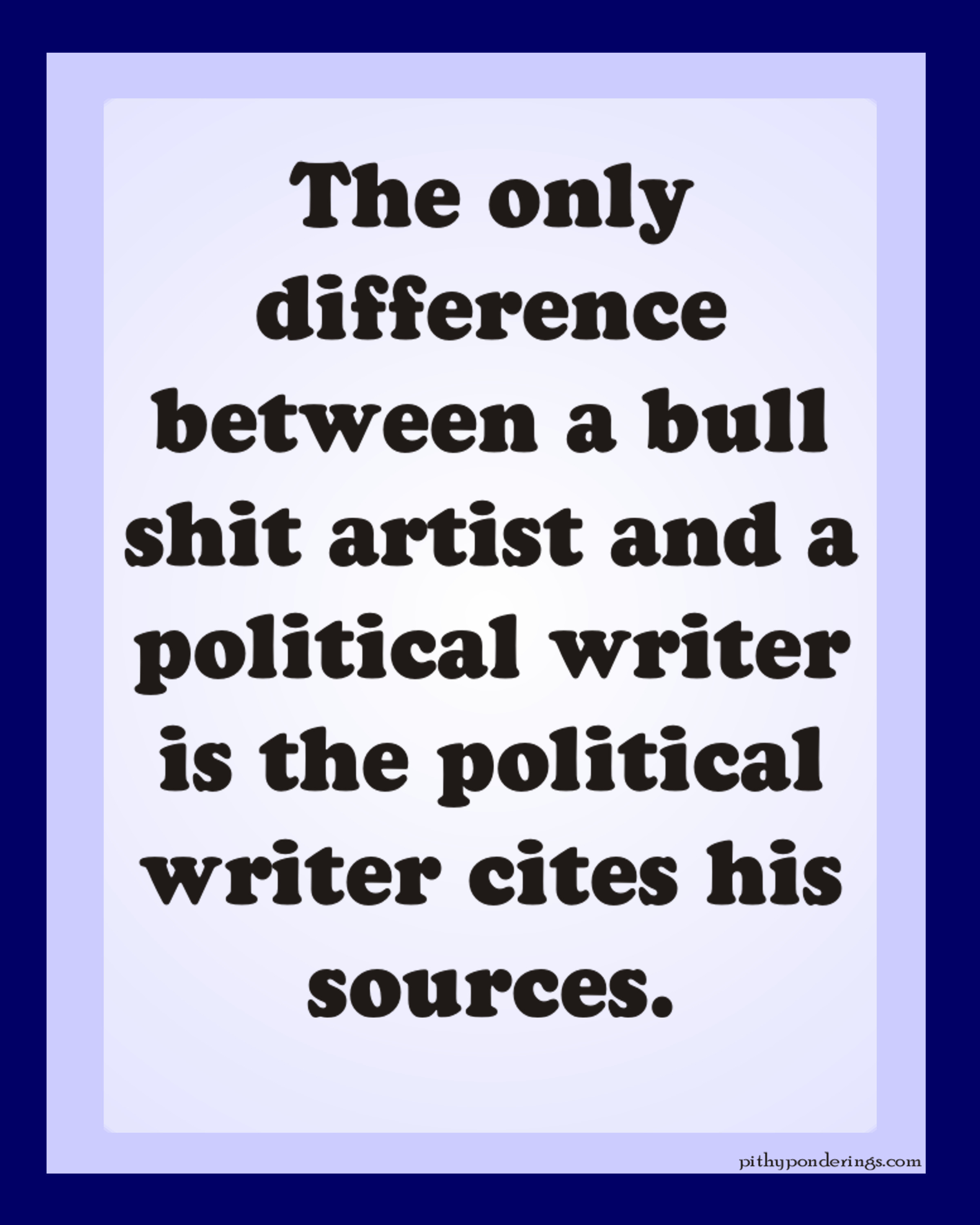
To Be Informed or To Be Educated

The citizens of the United States are distracted by political campaign information. They are embroiled in heated debate over healthcare. They argue about getting rid of the immigrants who long to support our economic and social system when they should be concentrating focus on the dangerous criminals who are the real threat. Therefore, they are missing the warning signs of other problems on the horizon.  One such international problem can be found just across the southern border as Mexicans go to their polls.

It is doubtful the President or the experienced members of congress are distracted from the international problems. Looking outside of the US, one sees that the US is not the only nation struggling with a poor economy, immigration issues, international crime and terrorism. What kind of a future does the US face, if a majority the ‘experienced’ leaders in DC are replaced by a whole new crew of 1st timers? Especially if the only agenda they bring with them is on the US economy, and on the US healthcare, and on the US borders.

The origins of US immigration policies are found in the early 1900’s during the time when isolationism was still being valued as good US policy. Isolationist policies, however, did not prove effective in the early 1900’s, they simply made the US late-comers for two wars for which joining was unavoidable.  In 1942 the internment policy of rounding up anyone “suspicious” was beyond contemptible, but it was policy.  Fear and a tremendous feeling of suffering dictated US domestic and foreign policies in the first half of the 20th century.

However at the same time the US was closing its borders, there was a social push to help its poor and downtrodden citizens.  Labor laws, workers unions, Social Security and legislation similar to the National School Lunch Act, all played a role in post war successes.  Due to economic policies during WWII, employer based health insurance became widely offered as well.   It was determined that prosperity was much easier to achieve if the nation was healthy rather than unhealthy. There was a need for the government to act, and the power of big government began to replace the power of big business.

Now a hundred years later, immigration and health care issues are at the center of US politics again.  Citizens are beginning to fear “others” and focusing on national issues while avoiding international issues.

Progress has been made but fear, misinformation, and “money” backed political theater will not keep the progress moving forward.  Talk of the “good ol’ days” is just talk.  If you are blessed to know survivors of those days, ask them about epidemics, outhouses, food shortages and social inequality.  It is a human trait to reminisce of the ol’ days. Selective memory is common, some prefer focusing on the good and some on the bad.  The citizens of the United States need to evaluate the good and the bad, the effective and the ineffective.

It is sad that with easy access to so much information, so many are misinformed.  A random comment posted concerning an editorial on the Supreme Court Healthcare ruling claimed, “We are becoming like the USSR.”  Many would like to blame this misinformed opinion on a failing educational system, but that would be unfair.  That would be like saying Fox News, or CNN, or MSNBC are to blame for all the ignorance in society. To quote a common saying, “guns don’t kill people, people kill people”, on that same reasoning, “cable news doesn’t make ignorance, people choose ignorance”.

Ignorance is conquered when an individual seeks information, evaluates the information by comparing it to other information, and then forms an opinion. This is how an individual becomes educated.  This how parents should be teaching their children. This is what voters should be doing before casting a vote.  This is what politicians should encourage.

While some journalists still prescribe to providing information rather than opinion, it is not up to them to educate us.  It is up to the individual to become educated and not simply informed.
Saith Me… Likability

The most important person you want to please is the person looking back at you in the mirror.

It is certainly better to be disliked and respected, than to be liked but held in contempt.

Just remember to be respected does not mean to be feared; and if everyone seems to dislike you, you might want to take a good hard look at your own nature.

However, if you are virtuous and kind to yourself and the world around you, yet still are not liked my the masses, you must be doing something right.  Keep up the good work, and maybe the masses will learn something from you.

Censorship or Good Neighbor

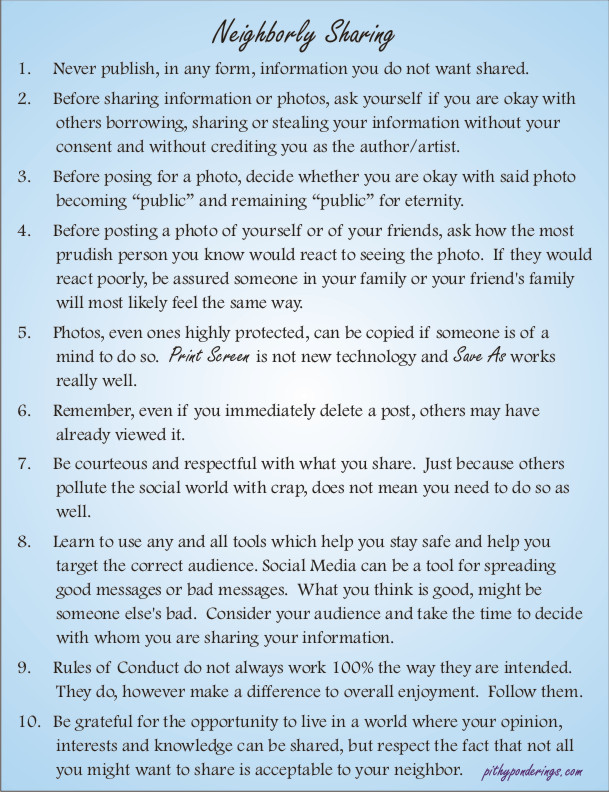
Is it censorship or a violation to constitutional rights when a privately owned company providing a service chooses to set decency policies?  In a recent Facebook debate, I read a multitude of criticism over Facebook deleting a photo some deemed objectionable and others deemed humorous.   The following are some questions that came to my mind.

  1. When does a privately owned company providing a service become so big that it is perceived as “public” space rather than a service?
  2. Why is an attempt to protect civility or decency perceived as a civil rights infringement to so many?
  3. When did the public come to conclusion it is a smart idea to save original data, photos or conversations on a server they do not personally own?

I have become a huge fan of using technology and social media to communicate with distant acquaintances and friends.  I have found social media to be an enjoyable way to connect, but I always utilize the advice of my mother, my journalism instructors and my own common sense.

Accountability

I have already written about the problem of entitlement and how society tends misplace the blame for this societal ill.  This is not the only area in which society is misplacing blame and avoiding individual accountability.

While reading an article today on the recession, and perusing the comments made in response, I once again was amazed at how accountability is sorely lacking in our society.  For the record, I believe that the role of the government is to safeguard the people, and understand that while regulations sometimes restrict economic progress, they can also aid in safeguarding the people.  With that being said, when I hear assertions that the recession is the fault of our most recent presidents, or Wall Street, I get a bit miffed.  Yes, Wall Street should be held accountable for their greedy actions and our government should have been more diligent in its oversight, but when are we the individuals going to accept the unpopular accountability for our own choices and actions?

When I read about how more young people need to live at home because they can’t afford their own place, or of the difficulties associated with buying or keeping a home, I wonder why we blame the government.  How is it that we can argue over government enforced healthcare, claim the government is interfering in our lives, yet at the same time cry foul that the government hasn’t helped us find a job or buy a home?

Don’t get me wrong, I feel for the people of our nation. This recession has hit us all in ways we did not foresee, but foreseen or not, we should have been better prepared.  Like any good Boy Scout will tell you, there is wisdom in the motto “Be Prepared”.  This can mean creating a plan if you live in a hurricane or flood zone, because the 100 year disaster may coincide with your lifespan.  It can mean having food storage or a generator if you live in an area that gets heavy snow.  It should definitely mean  becoming informed before you buy a home.   Owning a house is expensive and there are costs besides the mortgage you will pay.  Get informed before you buy, and if it will sap your budget, buy smaller or buy later.  A house can be a great blessing and investment, but don’t purchase the dream, invest in the reality.

Understandably it is hard to prepare for unemployment.  Often we live month-to-month barely getting by, and building a nest egg feels difficult to achieve.  However, young or old it is the responsibility of the able-bodied to be prepared and to be informed.  If this means having a back-up plan to sell your house and move in with relatives, or take on roommates, then be prepared to do so.

One report on housing states that we must go back to the 50’s to find so many multigenerational households.  I find this claim to be interesting.  Isn’t that the era in which our entitlement nature really sprouted?  New houses, new cars and new gadgets for the home; college educations a middleclass norm; and dreams of retirement at age 65 were the dreams of that generation.  Now the youth of the 50’s have grandkids and those grandkids are struggling to live up to, and pay for the dream.

Dreaming big is not a bad thing, but the recession was a reality check for everyone.  For dreams to become reality, hard work is required. This hard work does not follow an employer’s time-clock.  It does not retire.  It does not grow up and move out.  It does not get paid off.  The American Dream is bigger than a house, or a two car garage, or a retirement account.  It has more value than a vacation home, or a boat.  It is not measured by the size of your income or your bank account.

The American Dream for a secure tomorrow is not the responsibility of the President; it is the responsibility of the individual.  Our elected officials work for us, and if we are asking for all the wrong things, then that is what they will provide us.  The Preamble of the Constitution states:

We the people of the United States, in order to form a more perfect union, establish justice, insure domestic tranquility, provide for the common defense, promote the general welfare, and secure the blessings of liberty to ourselves and our posterity, do ordain and establish this Constitution for the United States of America.

It doesn’t promise a house, or a college education, or a car.  It promises justice, civil order and defense.  It promotes general welfare but does not promise it. Finally, it secures liberty.

The government of the United States does play a huge role in the nation’s prosperity, but the individual plays a greater role.  Citizenship is not like high school, where you get credit for showing up, doing the work and then going home.  Citizenship requires accountability for one’s own choices and actions.  Blaming others, especially the government, may seem easier, but in the long run, individual accountability will provide prosperity.

Answered Prayers

Prayers are often answered in the most unexpected ways. Preconceived notions can cause us to miss the answer when it comes. Therefore, we must always be receptive and alert.  Most especially, we should be grateful, regardless of how the answer is delivered or by whom.  The Lord will send us angles and answers to our prayer, but we must be willing to receive them.

Matthew 21:22

And all things, whatsoever ye shall ask in prayer, believing, ye shall receive.

A Chocolate Elephant

The following is a common saying in our household.

How do you eat an elephant?  

One bite at a time.

Well today we modified this saying.

How do you eat an elephant made of chocolate? 

One bite at a time – one bite every day.

Why the change?

First, chocolate seemed much more pleasant than thinking of eating a real elephant.  Second, to make it through something as big as an elephant, one needs to be consistent in the task.  Eating too much too fast can bring on all sorts of complications.  Taking too large of breaks between bites could cause problems as well.

So when you have an elephant of a task to tackle, daily bites will get the job done. Plus it never hurts to eat some chocolate along the way.

Parenting 101 – Risky Behavior

Risk: exposure to the chance of injury or loss; a hazard or dangerous chance.

It seems no matter how hard parents try, youth will dabble with risky behavior.  Never having been one to enjoy scary movies, this tendency has baffled me.  Living on the edge and taking risks for any reason is just not part of my nature.  Sure, in my 20’s I sometimes drove too fast, drank too much at parties, went running in areas many felt were unsafe, and pushed myself unceasingly to achieve a goal, but none of these actions were done for the thrill of danger or out of rebellion.  I was aware of the danger involved in my risky behavior and chose to take the risk, often in a need to prove something to myself rather than to others or for any kind of thrill.  In truth dangerous behavior makes me uneasy, anxious and rather ill, but for others it can be like an opiate.

Venturing into risky behavior is part of the nature of many youth and is not necessarily an indication of bad parenting. Conscientious parents face this reality quite frequently. Some succeed in teaching their youth that such behavior is dangerous. Some, despite their best efforts, do not.  Sadly some, through their well-meaning rules, regulations and restrictions, simply delay such lessons until their youth are no longer youth but legal adults.

Life is tough and sometimes in our youth, we make life tougher for ourselves and our parents.  Risky behavior is found all around us, encouraged by many in our society, and is a reality of life that is not new to our time in history.  Good people, old and young, choose to do foolish things.  This makes parenting a tough job, and too often a highly criticized one as well.