
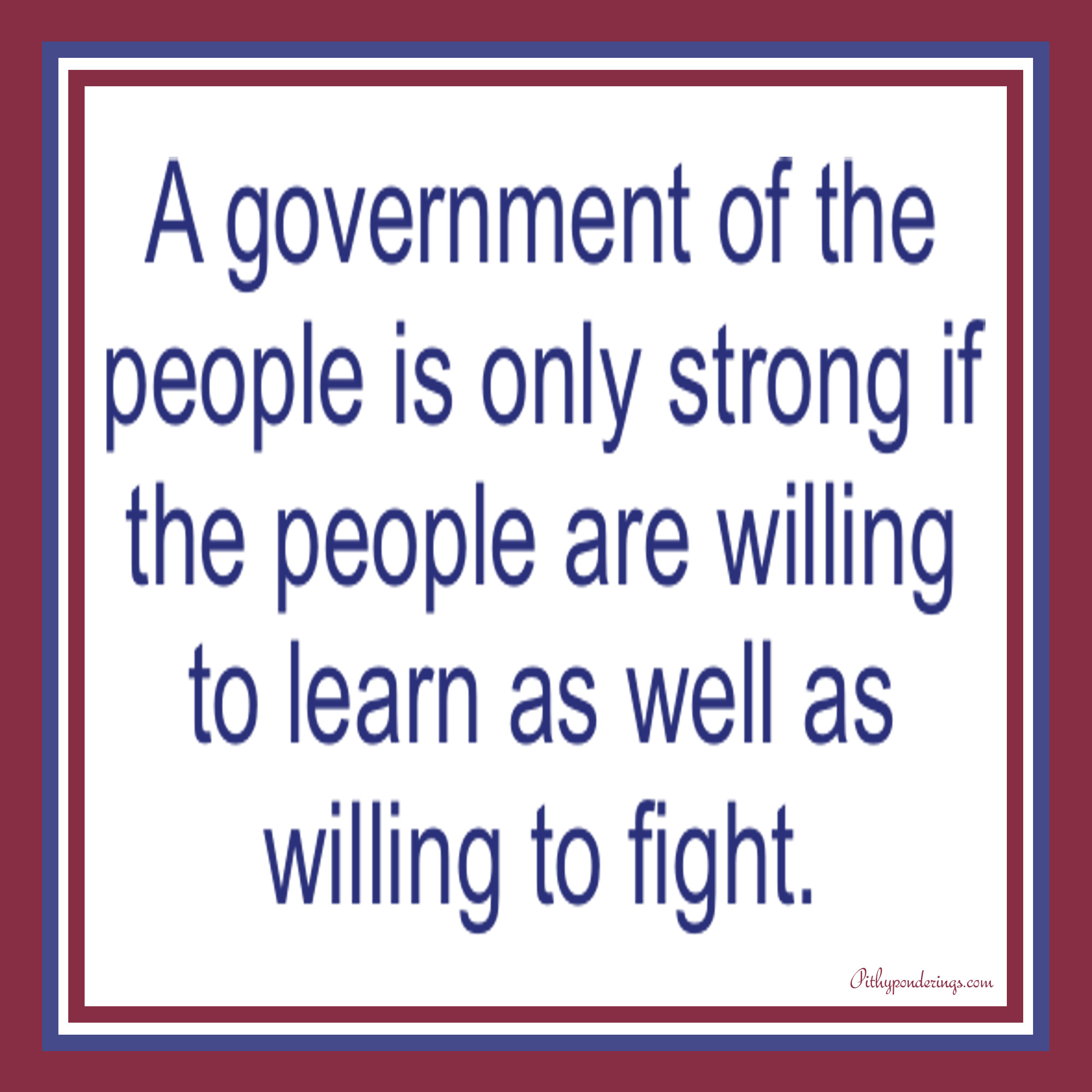
 The study of history should inspire us to seek more knowledge – not less.
Tag Archives: Political
Saith Me… Constitutionality of Ignorance
Oddly enough it was history and not current affairs that inspired today’s pithy. 
Critical Thinking and Pleasant Articulation
In the attached article, a recently retired high school teacher explains the troubling trend in education because of the high focus on standardized tests. While he attributes the problems to the federal policies of the last decade, the focus on standardized tests is not new and the side effects were present even 20 years ago, just not a prevalent. In the 1991-2 school year, I tutored a college freshman who was failing her International Relations class. The problem, as it turned out, was that she had never taken essay style tests and had never been responsible for taking notes in class in preparation for an essay style test. Yet she had graduated with honors from one of the best high schools in the nation.
The concerning issue highlighted in this article is the notion of “bad writing” as a scheme to excel on rubric graded writing. I am seeing the results of this type of thinking in my husband’s undergraduate classes and my graduate classes (online education affords us the opportunity to evaluate the other student’s ability to write). I have even had one graduate level professor criticize my work (with rubric attached) highlighting the dysfunction of the system. While I do not claim to be a literary genius, it is very disconcerting when a young professor is more concerned with checking boxes than with evaluating form and function. While more experienced professors seek a well-supported thesis, the younger ones are concerned more with whether every point of a lecture is covered, almost in bullet regurgitation in order to stay within a prescribed word count.
But this is not a completely new problem, just one more common as all facets of education require ease of grading.
Not all disciplines follow the same writing style and the variations can be troublesome for students who have not learned flexibility in writing. Many years ago a great conversation with a fellow student highlighted this point. She had received a poor grade on her paper and had been told to see mine for a comparison. She was appalled to find out that I had not followed the same essay format she had learned in high school English class. I explained that the standard essay she had learned under the strict tutelage of her high school instructor was not what our International Relations professor wanted us to write. He wanted us to write a critical essay highlighting what we THINK! What a notion – someone not only asking us to think but asking us to write it down. Students need to practice multiple styles of writing in order to gain the comfort of flexibility.
Thinking and standardized tests can sometimes cause problems for students, as I have witnessed with one of my two teens. My son, a person who sometimes thinks too much, receives decent scores on standardized tests, but not the stellar scores his younger sister receives. The instructor in the Washington Post article mentioned some of his students had taken Algebra in eighth grade. My son was taking physics when he began taking his ACTs and had a real struggle with the math section. It had been too long since he had seen simple math problems. Once he pulled out his old books and spent some time reviewing the simple, his math scores came up to snuff.
My daughter’s experience with the testing is slightly different because she likes to avoid analyzing but loves data. She is my ultra-creative child who has a near perfect memory.
My goal has been to teach my children to think, analyze, and then think some more. This had not been an easy task. My dedication to this task has left my children less prepared for the standardized tests they are required to take in order to get into the schools of their choice, but it was a risk worth taking. In the long run test scores will do little for them, but critical thinking and pleasant articulation will serve them for a life time.
On Strategy
“Strategy does not allow a nation to walk through the garden of war and politics unscathed. Strategic planning informs a nation of what it can do and can endure once it’s been pricked. Through planning, a nation can learn what it can endure and the depths of their adversary. It’s not about the plan. It’s about the planning.”
– Nicholas Torres, USAF, AMU Grad Student
– – – – –
*Nicholas is one of my classmates and has given me permission to quote him.
Saith Me… Evaluation of Successful Governance
No government will ever reach perfection, therefore their success must be evaluated on how well they return to law after war messes everything up.
Saith Me… Myth or History – Which do you Study?
People keep talking about the ills of our government, about our liberties being at risk and about how bad the nation is now. But I really wonder how many of them have ever studied any history – real history, the kind that goes beyond even the freshman level American History course of most colleges. Before they spout off about the loss of rights, do they really do their very best to understand the basis upon which those rights were created or do they simply agree with the masses screaming foul?
I often wonder if the propaganda material of 1770s and 1780s is all the people of today know about and whether they understand that not all the Founding Fathers agreed on the propaganda. The one thing they did seem to agree upon was creating a Constitution that did not hem us in but rather grew with us, adapted as we adapted, and outlived the political rhetoric of any one generation.
Lastly, I wonder if the spouting masses of today have any real idea of how much compromise those Founding Fathers put into not just the Constitution, but into the governance which then had to follow in order to provide for the protections the Constitution promised. Or how many times it took the threat of war before they would step down from their soapboxes and agree to compromise.
Maybe it is our turn to set aside the soapbox and pick up a scholarly history book, one that challenges our notions rather than simply tells the mythical side of the story.
Genuine Greetings of the Season

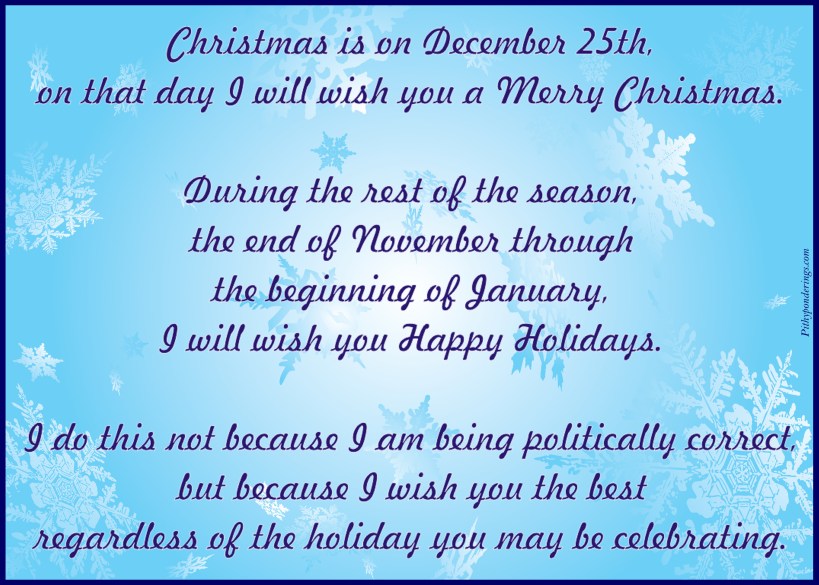
Whenever the media or friends discuss the war on Christmas these thoughts come to mind…….
I often wonder if “political correctness” is blamed for the decline in “Christmas” because Christians avoid looking at themselves and asking if they are teaching “Christmas” or teaching something else. It is easy to get fired up at the “attacks” but much harder to recognize that “Christmas” doesn’t just happen because you buy a tree and make cookies.
I really don’t think the lack of a nativity at the court house or public building will adversely affect my family, but the lack of one in my home certainly will. While it is sad to see public display of the holiday diminish, I do try to keep in mind that it is the traditions we make at home and share with our family and friends that count. I also remind myself that Hollywood’s version of Christmas is a rather new version and that the fundamentals of Christmas count more than how Hollywood defined Christmas to our parents and grandparents.
Whether I say Merry Christmas, Happy Holidays, or Season’s Greetings, I am wishing a person the best. Christ is only removed from Christmas when I forget to include him in my life, not when others exclude him from theirs. I would hope I live in such a way that people will still know I am Christian even when I wish them Happy Holidays. If nothing else, I hope they at least see the kindness in me when I wish them happiness.
A wish of cheer, in any form, is the message that carries on even after the lights and the tinsel get packed away for another year. Christ will never be removed from Christmas as long as well-wishers genuinely wish each other glad tidings at least once a year. This is part of the magic of the season; this genuine wish for blessings and cheer to be the companion of others. The Bleak Midwinter is replaced by a White Christmas the moment when a genuine greeting brightens someone’s day.
Saith Me… Sharing the Season
The Winter Season is not “owned” by just one group and respect for others is a good thing. Among other things, Christmas is about sharing, including sharing the season.
Saith Me and My Son… Fear
Fear is the easiest way to distract people from seeing issues clearly. It creates “something worse” and thereby allows bad to be perceived as good.
….
….
Is it a good thing when your kids start arguing with you as to whom the credit for pithy ponderings should go?
What history will teach us…
What history will teach us…

I recently saw a meme that defined treason as including giving aid to an enemy. It started me thinking about the debate over foreign aid and the role it plays in diplomacy. While I certainly agree that foreign aid must be scrupulously administered and should not be simply a default in the national budget, I disagree on the implication of who one might call our enemy*.
Interestingly, during the years between WWI and WWII the United States, while not enemies with Great Britain, saw Great Britain as being the greatest potential for threat to US security and prosperity**, second only was the rising threat of Japan. These threat assessments were based on the notion that with Germany having been weakened after WWI, a naval, and thereby commercial threat was only really viable by Great Britain and Japan.
Yet, when France fell and Great Britain became bombarded, President Roosevelt devised a scheme to aid Great Britain despite US isolationist rhetoric and congressional policy. So does that mean Roosevelt committed treason by helping a potential threat? Or does it simply mean that an unstable region, a region lacking a balance of power poses a greater threat to US security and prosperity than the potential threat of any one nation?
History teaches us that diplomacy and national policy is not as clear as political talking heads would like us to believe. I really don’t think history will record much of the opinion of the talking heads, rather history will view the intent, implementation, and result of policy. Then history will most likely teach us we were fools to listen to the talking heads in the first place.
* enemy is defined as a hostile nation or state. The presence of hostile factions does not make the state an enemy. Just as the US cannot universally control the ideas and actions of its citizens, the US cannot expect another nation to do that we cannot or will not do ourselves.
** National Security and Prosperity Interests was the terminology used prior to the Cold War when the language changed to National Security Interests.
 Pithy Ponderings