Propaganda works on those willing to listen either from fear or from prior conviction. It can plant seeds of doubt, however seeds of doubt turn into trees of knowledge for any willing to explore rather than be led.


Propaganda works on those willing to listen either from fear or from prior conviction. It can plant seeds of doubt, however seeds of doubt turn into trees of knowledge for any willing to explore rather than be led.
People keep talking about the ills of our government, about our liberties being at risk and about how bad the nation is now. But I really wonder how many of them have ever studied any history – real history, the kind that goes beyond even the freshman level American History course of most colleges. Before they spout off about the loss of rights, do they really do their very best to understand the basis upon which those rights were created or do they simply agree with the masses screaming foul?
I often wonder if the propaganda material of 1770s and 1780s is all the people of today know about and whether they understand that not all the Founding Fathers agreed on the propaganda. The one thing they did seem to agree upon was creating a Constitution that did not hem us in but rather grew with us, adapted as we adapted, and outlived the political rhetoric of any one generation.
Lastly, I wonder if the spouting masses of today have any real idea of how much compromise those Founding Fathers put into not just the Constitution, but into the governance which then had to follow in order to provide for the protections the Constitution promised. Or how many times it took the threat of war before they would step down from their soapboxes and agree to compromise.
Maybe it is our turn to set aside the soapbox and pick up a scholarly history book, one that challenges our notions rather than simply tells the mythical side of the story.
It is a good and noble thing to stand up for that in which you believe. Sometimes you may even need to fight for your beliefs, but remember when we choose to fight, we are seeking to change the will of others. Changing someone else’s will is not simply changing their mind, but changing their desire to resist the result you propose.
The decision to fight, to try to change someone’s will, should not be decided upon lightly. Even a fight of words can result in harm and injury. Before you start a fight, make sure your fight is for something in which you are willing inflict injury to achieve. Be sure the thing you are willing to injure others over has a great enough value that it will offset the damage you will cause.
We can stand on principles without resorting to a fight, but to do so we much have respect for the principles upon which others stand. In almost all cases, it will be better to stand than to fight. It is a profound task to figure out the exceptions.
Fear is the easiest way to distract people from seeing issues clearly. It creates “something worse” and thereby allows bad to be perceived as good.
….
….
Is it a good thing when your kids start arguing with you as to whom the credit for pithy ponderings should go?
What history will teach us…

I recently saw a meme that defined treason as including giving aid to an enemy. It started me thinking about the debate over foreign aid and the role it plays in diplomacy. While I certainly agree that foreign aid must be scrupulously administered and should not be simply a default in the national budget, I disagree on the implication of who one might call our enemy*.
Interestingly, during the years between WWI and WWII the United States, while not enemies with Great Britain, saw Great Britain as being the greatest potential for threat to US security and prosperity**, second only was the rising threat of Japan. These threat assessments were based on the notion that with Germany having been weakened after WWI, a naval, and thereby commercial threat was only really viable by Great Britain and Japan.
Yet, when France fell and Great Britain became bombarded, President Roosevelt devised a scheme to aid Great Britain despite US isolationist rhetoric and congressional policy. So does that mean Roosevelt committed treason by helping a potential threat? Or does it simply mean that an unstable region, a region lacking a balance of power poses a greater threat to US security and prosperity than the potential threat of any one nation?
History teaches us that diplomacy and national policy is not as clear as political talking heads would like us to believe. I really don’t think history will record much of the opinion of the talking heads, rather history will view the intent, implementation, and result of policy. Then history will most likely teach us we were fools to listen to the talking heads in the first place.
* enemy is defined as a hostile nation or state. The presence of hostile factions does not make the state an enemy. Just as the US cannot universally control the ideas and actions of its citizens, the US cannot expect another nation to do that we cannot or will not do ourselves.
** National Security and Prosperity Interests was the terminology used prior to the Cold War when the language changed to National Security Interests.
 We see what we want to see, we hear what we want to hear and then we criticize our political representatives when they represent our narrow points of view and cannot get anything done.
Hmmm…
When the hearts of the many are hardened and are accepting of hate, it is then there will be woe among mankind and iniquity will prevail.
– Pioneer Lady

Gandhi described anger and intolerance as being the enemies of correct understanding, but they are also the enemies of reason. They spread misunderstanding.
People will disagree on principles, or on the details of an issue, but that is not the same as standing on misinformation, calling it truth, and asserting all others are wrong in their beliefs. Correct understanding therefor is not just the ability to understand, but the ability to understand the opposition and the ability to reason rather than simply rationalize.
If only the issues could be boiled down into a meme or a sound-bite, the debate might be more civil. But what one sees as unconscionable another sees as freedom; what one sees as dependency another sees as progress. We are not the first generation to struggle over weighty issues, even the founding fathers ferociously disagreed and struggled for compromise.
When we develop passionate views on an issue, we need to remember that it was compromise that got us to this point in history and not the views of just a few. When compromise failed, however, war broke out. And of all presidents in the history of the U.S., even Lincoln, it can be argued that this president understands what is at stake. For when the nation divided the last time, it was over whether some should be free and some should not. But as all our presidents soon learn upon entering office, guaranteeing liberty is not always simple.
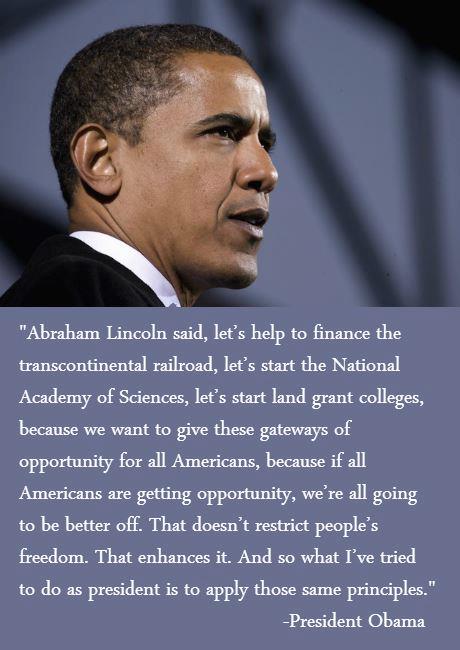
He is the President of the United States of America and the lack of respect he has been shown for his willingness to serve the people has been appalling and divisive.
History will not just judge him, but will also judge the people he has served.

People who only have cell phones do not usually get hit by pollsters. Pollsters therefore “overweight” the results for the 18-30 year old bracket to offset the numbers. So do more Democrats (Ds) or more Republicans (Rs) only have cell phones?
Of course I hang up on all pollsters which makes me wonder, do more Ds hangup than Rs or more Rs than Ds?
Now wouldn’t these questions make for good news coverage. But wait, how would the data be collected since people like me don’t play along with all the polling?
I woke up this morning with an odd thought…
Are national educational issues, national health issues, national economic issues, and national security issues all intertwined?
Can we have one without the others?
A thing to ponder…
Trivia – prior to NSC 68, “National Prosperity and Security” was the vocabulary of politicians and not “National Security.”
 Pithy Ponderings