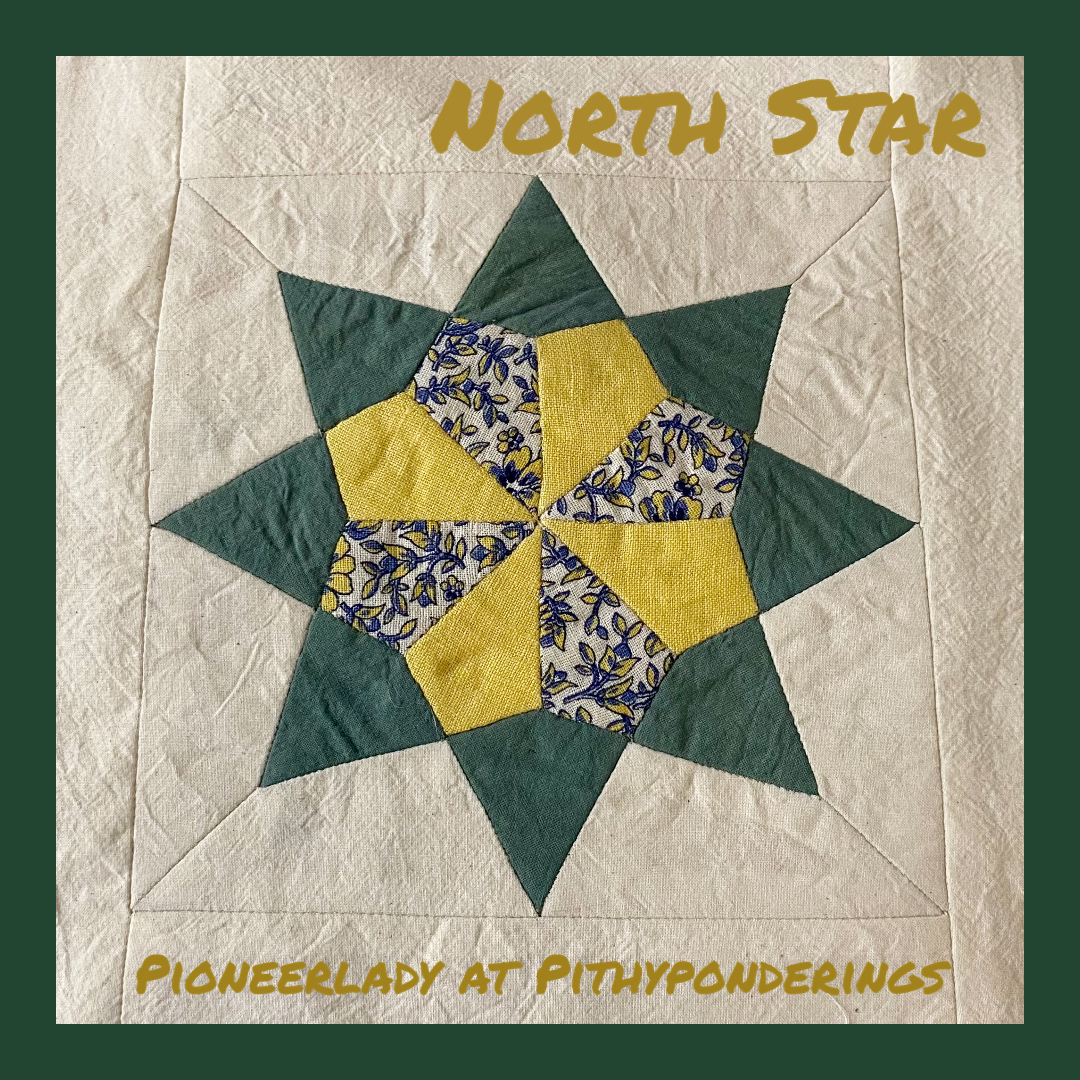
A block that benefits from the use of light, medium, and dark contrasting fabrics for greatest impact. It is also stunning when made with a low contrast collection of fabrics.
Still using 4 different fabrics, the blues are low contrasting for a subtle effect. Another option is to make it using one star fabric and one background fabric.
When the background fabric is changed to a dark contrast, the effect is dramatic.
This quilt layout uses 4 of the North Star blocks and a thin 1 inch border. Its finished size is 22 inches square.
~~~~~~~~~~~~~~~~~~~~~~~~~~
This week’s vlog shares my finished Halloween Quilt and some handy zippered bags. I include resource link in the vlog description for those wanting to try the zippered bag either with machine embroidery or with traditional sewing methods.
In the world of crafting, the UFO is anything but a rare occurrence. UnFinished Objects, the UFO, can also be called unfinished fiber objects in the world of knitting and crochet. At its heart, the UFO is simply a project that, once stated, was never finished. It is important to distinguish the UFO from the Grab n Go projects many crafters keep at a ready for times when crafting is out in the wild (dentist’s office’s lobbies, children’s school performances, stressful social engagements). It is also important to note that the UFO should not be mistaken for the slow projects kept on hand for the occasional break from the must-make-as-fast-as-possible projects and what-was-I-thinking projects which often dominate the crafters time. The UFO is separate from the rest, often because it is tossed into a hidden corner and somewhat forgotten.
However, this languishing UFO is not the only type of UFO in the crafter’s universe. Sometimes a UFO is simply a project put aside because life gets in the way of finishing. It might even be relegated to the infamous To Do pile, much like mending a favorite item of clothing. Every indication says that it will get done, just not at this particular moment. These UFOs are often the joy-filled projects a crafter begins but a misjudgment of time for completion occurs.
It is one of these latter types of UFO I completed this week along with all my other fiber and fabric fun. I share my UFO bag, this week’s English Paper Piecing block, and a few quick projects in my vlog.
What’s it name? This week’s English Paper Piecing block may be traditionally called The Spool, but in my world the spool of thread and the bobbin of wool compete for dominance. Whatever you choose to call it, this block pattern adds a bit of a spin on the standard block pattern.
The pattern for this block can be downloaded here.
English Paper Piecing dominates my days, especially since there are so many seasonal inspirations simply begging to become EPP projects. This week I am sharing two blocks for my ongoing EPP quilt project, plus a quilt pattern I’ve named Ghosts & Lanterns.
In addition to these EPP projects, I share more seasonal projects in this week’s podcast. With autumn breezes finally cooling the air, I have returned to my sewing room with excitement. In fact, that is were I am off to now.
Happy Unwinding with Fiber and Fabric💜
~~~~~~~~~~~~~~~~~~~~~~~
Patterns for this week’s blocks can be downloaded here.
From my earliest days of quilting, I have been drawn to star blocks. Whether created by using half-square triangles or diamonds, they never fail to entice me. However as far as ease of construction goes, they have caused me frustration. Maintaining each and every point on a star is not the easiest of tasks, especially when in a hurry to see the project finished. Switching to a slower process like English Paper Piecing, much like with foundation piecing, offers a way to get precision with less frustration. In the past, I have dabbled with foundation piecing as a way to get my star blocks precise, but while I did enjoy the process, it never clicked for me like EPP has. Maybe my new found love of EPP has a great deal to do with my current need to slow down just a bit.
During periods of life when the future is more unsure than what we have come to expect, or when we feel like we are standing on shaky ground, slow-crafting has the potential to calm our mind. While finished objects and busy hands often motivate the hand-crafting world, many crafts can be done with speed without the loss of accuracy. EPP, like other hand sewing crafts, requires focus, even when the skill is performed by the hands of a master. Every stitch is placed in just the right spot to create strength, yet small enough to seemingly disappear when the block is finished. Over time, rhythmic precision develops, but focus is still required.
Working with an EPP block offers the crafter a choice –
focus on the stitches while also focusing on a movie or audio book so that you mind won’t wander,
or focus only on the stitches so your mind will wander with the hope that it will work through the stresses of the day.
As hand-crafters, we often choose our patterns and projects with these two choices in mind. It is likely the reason why we keep so many projects going at the same time. We have projects that fit for both of the choices above, so we can easily pick one based of the need of the moment.
Right now, my need has me picking a project that keeps me focused on my hands rather than focused things outside my control. In truth, I’m not at all surprised I have gravitated to so many star blocks as I plan out the EPP quilt. Whether wishing on a star, or simply taking in their sparkling beauty, star gazing, much like slow-crafting can quiet the mind during troubled times.
One of the most iconic quilts of the 20th century is the Granma’s Flower Garden. Made from hexagons combined to create the appearance of flower petals, this design has been created with one unit – the hexagon. The concept and design has also appeared in crochet, with the hexagon replacing the more common Granny Square. Whether sewn or crocheted, the look is memorable and inviting.
Putting a spin on the more common block, the Hexagon Pinwheel adds the twist of piecing together the center hexagon before building the floret. I have added one additional twist and placed the floret into a pieced block. As with other similar designs, it would be easy to simply applique the floret onto a solid background, but I have chosen to challenge myself. It would be perfectly acceptable for others to bypass this challenge. There would be nothing wrong with cutting an 11 inch square of fabric, applying the constructed floret, and then trimming the block to 10.5 inches. Sometimes, one twist in a project is more than enough.
Precision and Just Winging It can work together, especially when playing around with paper piecing.
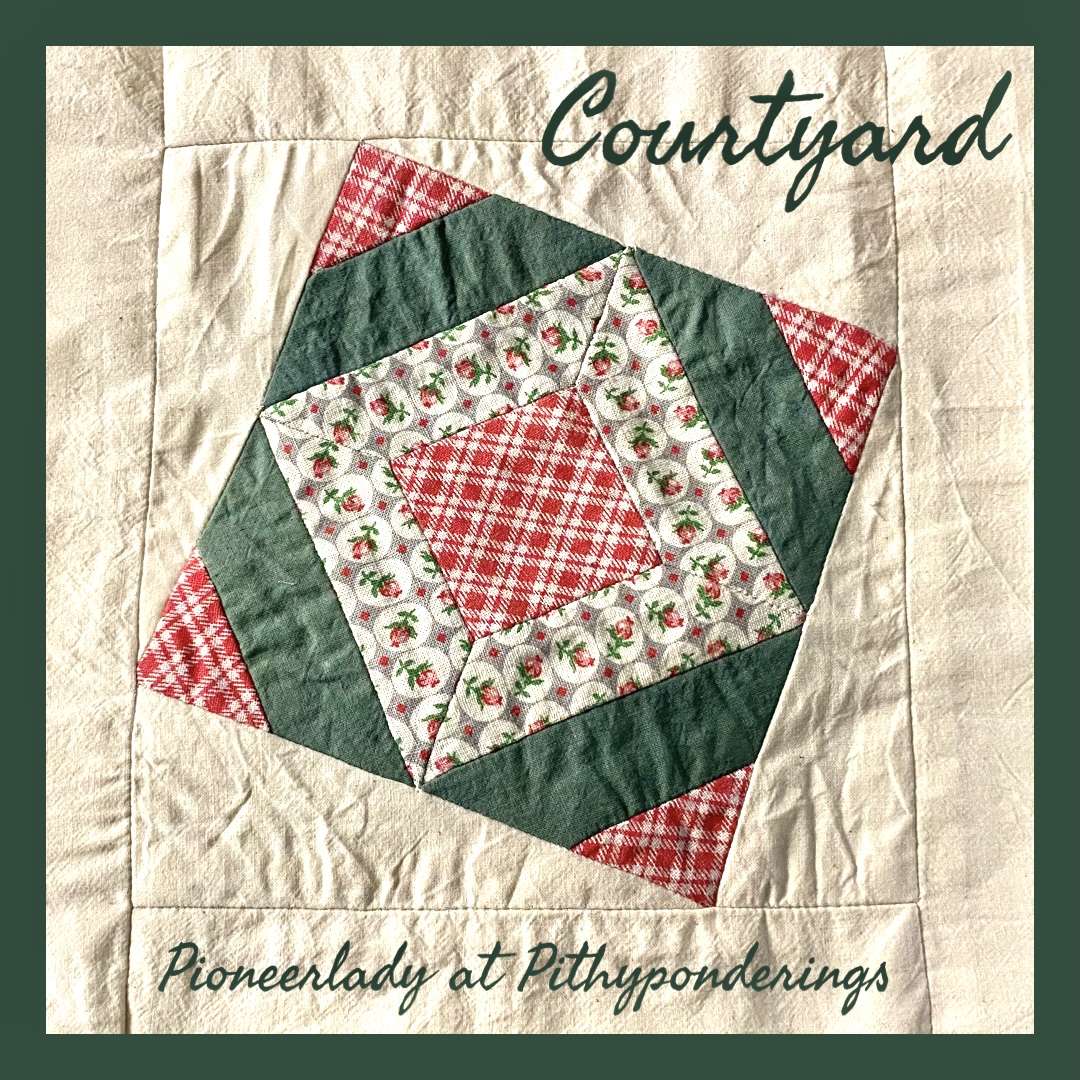
The first block in a series of paper pieced blocks I plan to make (and share) over the next few months. I have a rough plan for a sampler quilt drafted in my quilting software*. For the blocks, I plan to use a combination of vintage fabrics I have collected over the years, hand dyed fabrics I created early in my dyeing exploration, and some unbleached muslin I have in abundance. I will decide on sashing fabric once all the blocks are constructed.
Each of my blocks will finish as 10″ blocks (including the cream borders). I am hand sewing each of the blocks, but will likely construct the quilt top by machine once I reach that point of the process. Many of the blocks are variations of traditional blocks. In most cases, the major modification was to set them into the block borders.
While most of these blocks could be constructed using other methods than English Paper Piecing (EPP), the scale of the blocks makes EPP the best choice. I will provide a pdf with fabric recommendations and template sheets. The template sheets have been arranged for ease of printing directly onto cardstock.
I share the Evening Star block in the second half of today’s podcast.
Inspired by an younger generation of quilters and an ever-growing scrap fabric stash, I decided to give English Paper Piecing (EPP) a try. I quickly fell in love with the rhythmic quality of sewing small pieces of fabric together. The secret to my success has been to use thick cardboard rather than paper for my template pieces. Since I am glue basting the fabric to the templates, the thickness is not a problem but instead provides me with something more substantial on which to hold. I will admit, having the ability to laser cut out all my templates is a huge help. While I certainly could have just purchased pre-cut shapes and worked on patterns from those shapes, I decided to give myself the challenge of designing blocks in computer software so that I could share what I was doing with others.
Harvest Berries is the first of the EPP blocks I plan to share over the next year. I chose it to be first because it is built on one of the most beloved EPP shapes – the hexagon. I chose to applique this block onto a solid background rather than to combine it with many others to make a hexagon quilt. While I used 1.5″ (side measurement) hexagons although any size hexagon could work for this pattern. I have provided a pdf with the templates, but precut hexagons can be purchased from many sites.
Harvest Berries was a fun block to make, and it is a great pattern to introduce a beginner to the world of EPP.
Imperfection fades away, replaced by snuggly comfort.
In the crafting world, the stress created by seeking perfection is offset by a simple 3-foot rule. Whatever is not noticeable from 3 feet away should not cause the maker angst. While this rule is not always as effective as one might hope, when it comes to quilting, there is an additional rule that usually covers all but the most egregious flaws. The comfort rule.
If the quilt provides comfort, then the quilt needs only be structurally sound to be perfect.
Sometimes in life, we lose perspective, focusing too much on imperfections rather than on purpose.
“What is the purpose of what we do?” “What is the goal we hope to achieve?”
There will always be situations where perfection must be the purpose, but those situations rarely extend beyond life-saving, safety-critical, or technology-focused tasks. In most cases, seeking perfection is a goal but not the purpose of the endeavor.
When we focus the purpose of our task, imperfections fade away to be replaced by the comfort a good perspective on life provides.





 Pithy Ponderings