What’s it name? This week’s English Paper Piecing block may be traditionally called The Spool, but in my world the spool of thread and the bobbin of wool compete for dominance. Whatever you choose to call it, this block pattern adds a bit of a spin on the standard block pattern.
The pattern for this block can be downloaded here.
English Paper Piecing dominates my days, especially since there are so many seasonal inspirations simply begging to become EPP projects. This week I am sharing two blocks for my ongoing EPP quilt project, plus a quilt pattern I’ve named Ghosts & Lanterns.
In addition to these EPP projects, I share more seasonal projects in this week’s podcast. With autumn breezes finally cooling the air, I have returned to my sewing room with excitement. In fact, that is were I am off to now.
Happy Unwinding with Fiber and Fabric💜
~~~~~~~~~~~~~~~~~~~~~~~
Patterns for this week’s blocks can be downloaded here.
Precision and Just Winging It can work together, especially when playing around with paper piecing.
The first block in a series of paper pieced blocks I plan to make (and share) over the next few months. I have a rough plan for a sampler quilt drafted in my quilting software*. For the blocks, I plan to use a combination of vintage fabrics I have collected over the years, hand dyed fabrics I created early in my dyeing exploration, and some unbleached muslin I have in abundance. I will decide on sashing fabric once all the blocks are constructed.
Each of my blocks will finish as 10″ blocks (including the cream borders). I am hand sewing each of the blocks, but will likely construct the quilt top by machine once I reach that point of the process. Many of the blocks are variations of traditional blocks. In most cases, the major modification was to set them into the block borders.
While most of these blocks could be constructed using other methods than English Paper Piecing (EPP), the scale of the blocks makes EPP the best choice. I will provide a pdf with fabric recommendations and template sheets. The template sheets have been arranged for ease of printing directly onto cardstock.
I share the Evening Star block in the second half of today’s podcast.
Inspired by an younger generation of quilters and an ever-growing scrap fabric stash, I decided to give English Paper Piecing (EPP) a try. I quickly fell in love with the rhythmic quality of sewing small pieces of fabric together. The secret to my success has been to use thick cardboard rather than paper for my template pieces. Since I am glue basting the fabric to the templates, the thickness is not a problem but instead provides me with something more substantial on which to hold. I will admit, having the ability to laser cut out all my templates is a huge help. While I certainly could have just purchased pre-cut shapes and worked on patterns from those shapes, I decided to give myself the challenge of designing blocks in computer software so that I could share what I was doing with others.
Harvest Berries is the first of the EPP blocks I plan to share over the next year. I chose it to be first because it is built on one of the most beloved EPP shapes – the hexagon. I chose to applique this block onto a solid background rather than to combine it with many others to make a hexagon quilt. While I used 1.5″ (side measurement) hexagons although any size hexagon could work for this pattern. I have provided a pdf with the templates, but precut hexagons can be purchased from many sites.
Harvest Berries was a fun block to make, and it is a great pattern to introduce a beginner to the world of EPP.
Imperfection fades away, replaced by snuggly comfort.
In the crafting world, the stress created by seeking perfection is offset by a simple 3-foot rule. Whatever is not noticeable from 3 feet away should not cause the maker angst. While this rule is not always as effective as one might hope, when it comes to quilting, there is an additional rule that usually covers all but the most egregious flaws. The comfort rule.
If the quilt provides comfort, then the quilt needs only be structurally sound to be perfect.
Sometimes in life, we lose perspective, focusing too much on imperfections rather than on purpose.
“What is the purpose of what we do?” “What is the goal we hope to achieve?”
There will always be situations where perfection must be the purpose, but those situations rarely extend beyond life-saving, safety-critical, or technology-focused tasks. In most cases, seeking perfection is a goal but not the purpose of the endeavor.
When we focus the purpose of our task, imperfections fade away to be replaced by the comfort a good perspective on life provides.
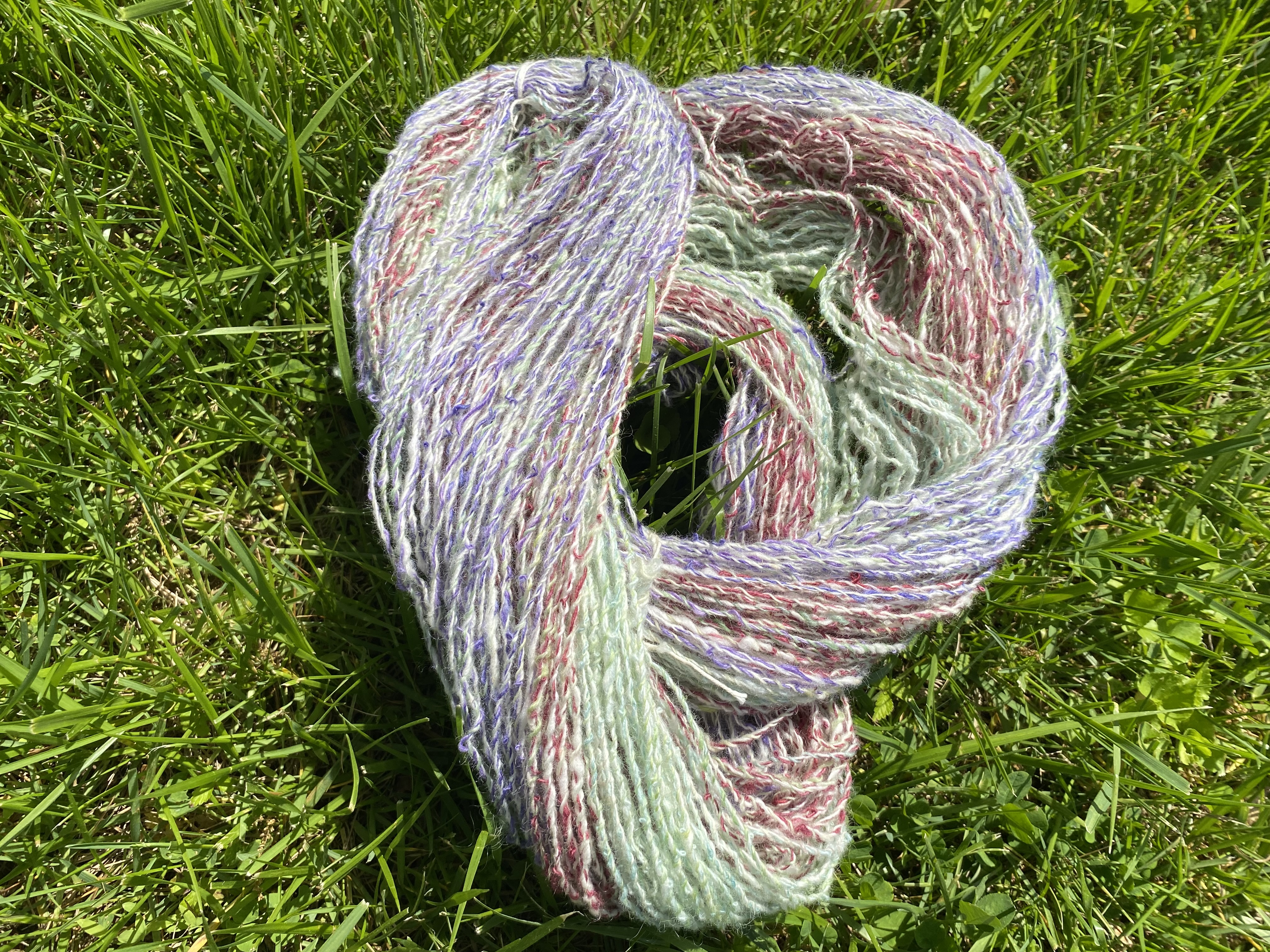
We’ve all heard the saying “when life’s hands you lemons…” In the world of making yarn, the result of this can-do attitude often results in unique creations. In the case of this particular yarn, a bobbin of “oops” was combined with some left-over “forgot what it was” which produced a “crazily energetic yarn”. Not to be discouraged, I then added some “I think I know what it is” into the mix. The resulting yarn is unique, but it is also quite functional.
Oops Yarn is also a reminder to embrace the mistakes in life’s journey. If we need a good cry, then we should cry. If we need a good laugh, then we should laugh. The thing we shouldn’t do is throw out the mistake or pretend it didn’t happen. Life is full of mistakes, but like the Oops Yarn, there is value to be had if we embrace them rather than toss them away.
In my latest vlog, you can hear all about my Oops Yarn as well as some projects that went as planned.
The smell of cookies baking, the extra warmth from the oven, and the comfort of a sweet treat, lots of reasons to mix up another batch of cookies. This time it is the Peanut Butter Cookie, which I have reduced to a small batch bake for those of us seeking a small indulgence rather than a mountain of cookies. If you do need a larger batch, no worries, this recipe is very simple to multiply when more than two dozen nutty delights are needed.
Important Tip:
Not all peanut butter is made the same. The peanut butter made in the U.S.A. is a sweeter cousin to the peanut butter made elsewhere. It is perfect for peanut butter and jelly sandwiches, peanut butter cookies, and other peanut butter sweet treats. So if you are not in the United States, see if you can source some from the international section of your grocery store.
If you don’t already have mini ice cream/cookie scoop in your kitchen, treat yourself to one of two. They are a time saver when working with a wet cookie dough or when trying for consistent-sized cookies. I prefer the small one often used as a melon baller for this recipe (1/2 tablespoon). The cookies with spread during baking so a little dough goes a long way.
A Vlogmas Spin-a-long with a Sweet Treat at the End
The spices of the holiday season evoke memories of family get-togethers, fresh-from-the-oven baked foods, and warm beverages. Recreating these tastes and smells can lead to an overabundance that is not always a good thing. Figuring out how to make smaller batches of spicy treats has been my goal these past few months, and I am ready to share the results.
This blog coincides and supports my latest vlog where I talk about the fun I have had making pies for a household of two. As I mention in my vlog, I use an Instant Vortex Air Fryer, which is just a fancy name for convection toaster oven. There are other mini convection oven/toasters on the market, but this is the brand I have used. The recipes I am sharing can easily be made in a regular oven or convection oven, but during those hot late-summer months, it was so very nice to have recipes that could be made in a small oven and didn’t heat up the kitchen.
I hope you check out my video and enjoy these spiced up treats.




 Pithy Ponderings