
Genuine Greetings of the Season

Ornament 01

Whenever the media or friends discuss the war on Christmas these thoughts come to mind…….

I often wonder if “political correctness” is blamed for the decline in “Christmas” because Christians avoid looking at themselves and asking if they are teaching “Christmas” or teaching something else. It is easy to get fired up at the “attacks” but much harder to recognize that “Christmas” doesn’t just happen because you buy a tree and make cookies.

I really don’t think the lack of a nativity at the court house or public building will adversely affect my family, but the lack of one in my home certainly will. While it is sad to see public display of the holiday diminish, I do try to keep in mind that it is the traditions we make at home and share with our family and friends that count. I also remind myself that Hollywood’s version of Christmas is a rather new version and that the fundamentals of Christmas count more than how Hollywood defined Christmas to our parents and grandparents.

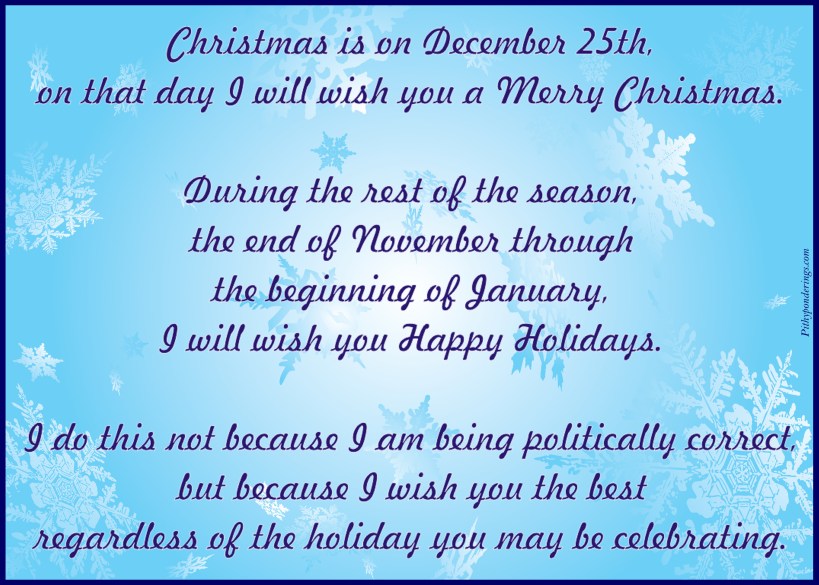
Whether I say Merry Christmas, Happy Holidays, or Season’s Greetings, I am wishing a person the best. Christ is only removed from Christmas when I forget to include him in my life, not when others exclude him from theirs. I would hope I live in such a way that people will still know I am Christian even when I wish them Happy Holidays. If nothing else, I hope they at least see the kindness in me when I wish them happiness.

A wish of cheer, in any form, is the message that carries on even after the lights and the tinsel get packed away for another year. Christ will never be removed from Christmas as long as well-wishers genuinely wish each other glad tidings at least once a year. This is part of the magic of the season; this genuine wish for blessings and cheer to be the companion of others. The Bleak Midwinter is replaced by a White Christmas the moment when a genuine greeting brightens someone’s day.
Saith Me… To Stand not Fight

It is a good and noble thing to stand up for that in which you believe. Sometimes you may even need to fight for your beliefs, but remember when we choose to fight, we are seeking to change the will of others. Changing someone else’s will is not simply changing their mind, but changing their desire to resist the result you propose.

The decision to fight, to try to change someone’s will, should not be decided upon lightly.  Even a fight of words can result in harm and injury.  Before you start a fight, make sure your fight is for something in which you are willing inflict injury to achieve.  Be sure the thing you are willing to injure others over has a great enough value that it will offset the damage you will cause.

We can stand on principles without resorting to a fight, but to do so we much have respect for the principles upon which others stand. In almost all cases, it will be better to stand than to fight.  It is a profound task to figure out the exceptions.

Saith Me… Old Books

Over the past couple of years, I started collecting old books, not books with great potential for monetary appreciation or the need for insurance policies.  Certainly not books to be kept behind the safety of glass, but books conveying the ideas of past generations on common subjects like knitting.  My collection began with an out-of-print sequel to a more famous literary novel.  The book was worn and tattered but satisfied the craving to know “what happened next.”

The ease in which this book was purchased made me curious to see what else I could find.  School books dating to 1900 led to the fascinating discovery that young women of that “new” century did not necessarily like the idea of home economics and needed encouragement through a form of literary fiction; the ancestor of the self-help TV programming.

Recently an online sale of old books caught my eye and I wondered if I could find some gems to help with a paper I am working on for class.  Justifying the purchase as an early Christmas present, I sifted and sorted (electronically of course) through the stacks of old books. When my purchases arrived I sorted them into the now and later stacks with the now joining me in my office for study.

One particularly delightful old book just begged for perusal and offered up a poignant quote, but the author had been hesitant to sign his name, making citation difficult. No author, no editor just a mysterious professional title. How very odd and rather mysterious (politically mysterious as it would turn out).

However it seems I was not the only one who had questioned this author’s identity.  In 1955 the book first left the original owner’s hands and a note had been written in the front cover explaining the personal, though cryptic inscription.  The author’s name was written by hand by the bookstore agent purchasing the book, along with a brief explanation of the book’s purchase. The book buyer also hand wrote the resale price of $.50, quite the sum I am sure.

Upon conducting a quick internet search, I verified the accuracy of the author’s name and thereby realized that my copy had been a gift from the author to some initialed friend.  In addition to being the author of multiple books on diplomacy, the mysterious man who published his first book anonymously had been a U.S. ambassador in the years that followed the publication.

Old books certainly have stories to tell.

Saith Me and My Son… Fear

Fear is the easiest way to distract people from seeing issues clearly. It creates “something worse” and thereby allows bad to be perceived as good.

….


….

Is it a good thing when your kids start arguing with you as to whom the credit for pithy ponderings should go?

Saith Me… The Hardened Heart

When the hearts of the many are hardened and are accepting of hate, it is then there will be woe among mankind and iniquity will prevail.
– Pioneer Lady


Gandhi described anger and intolerance as being the enemies of correct understanding, but they are also the enemies of reason.  They spread misunderstanding.

People will disagree on principles, or on the details of an issue, but that is not the same as standing on misinformation, calling it truth, and asserting all others are wrong in their beliefs.  Correct understanding therefor is not just the ability to understand, but the ability to understand the opposition and the ability to reason rather than simply rationalize.


Why I write…

Why do we write in blogs, journals, or memoirs? Is it because we like to see our ideas take shape, or think our messages are profound or revolutionary? Or do we simply write with the hope that they will have value today or tomorrow, have value to or for someone we will probably never meet?

A few weeks ago, a professor asked the question of why should we study history, but the real question, for me at least, is why do we write history? Why do we write our own history in our blogs, journals, and memoirs, a written record of our thoughts and actions? I think we write for three reasons. The first, we hope we are interesting and hope our activities will be of interest to others. The second, we hope that by writing our experiences down, we will learn lessons from our experiences and maybe others will learn from us as well. Third, we do not want to forget our experiences or be forgotten.

These are all valid reasons to write, but a great man taught me one other reason to write. He taught me that we can serve others through our writing, through our research, and through our records. Not just through the lessons or experiences we share, but through the lives of others we preserve through written record.

This great man, great to me at least, passed away two days ago. He had dedicated his retired years to gathering and recording history; specifically the history of his ancestors. Through his work, volumes of information became available to his relatives and to the public. He was never famous and never sought fame, but in certain circles, he was well known and well loved. Most of the histories he wrote were the histories of others, but upon his family’s request he wrote of his own youth and of his experiences as a World War Two POW. When he wrote of his journey in life, it was not to gain fame or attention, but simply to leave a record; a humble record of a man who spent his life serving. Through his life, he served his family, his faith, and his nation.

He set the bar high for those of us who follow, but in doing so he taught us the value of service and the blessings that service brings to our fellow man, to our family, and to ourselves. For in blessing others, he was truly blessed; in loving others he was loved in return.

So why do I write, simply put, to emulate in my own way a great man – I write with an attempt to serve others.

A Great-Uncle and a Great Man!

Saith Me… Liberal Arts Education

This morning one of my college alumnae Facebook groups asked how we have used our liberal arts educations.  This was my reply…

Well, I have worked for a few different states, in jobs I could never have imagined, when I was in school, occupying upon graduation, but it has been my sixteen year stint as a mom and my twelve years as a homeschool teacher in which my education has been most useful. Randolph-Macon Woman’s College taught me that there is intelligence and there is wisdom, and that it takes both to succeed. It certainly takes both to raise the next generation with any chance of survival. For it is clear they are smarter than we, but it rests on us to teach them wisdom.

Embracing Identity Through The Written Word

To most of the world, my son seems sullen and distant, but he deeply loves mankind and mourns for their troubles. His sullen appearance is just the outward refection of his deep concerns for the sorrows of man and his passionate desire to assist the downtrodden.

To most of the world, my daughter is sweet and domestic, but she is the ferocious defender the weak. If there is a crusade to join, an injustice to correct, my daughter’s dimples and giggles are quickly replaced by a threatening growl and a merciless strike.

The world seldom sees my children’s true nature, for in their youth they still hide their identity, feeling it offers them protection.  But every so often they let down their guard and the world sees their nature. Often it is through their writings.

Teaching my children to write has been my goal, not simply for the normal communication reasons, but because writing is an outlet for them to freely express their nature. My son has learned to share ideas, life lessons, and words of compassion through writing. My daughter has learned to replace her fists with words. They are young and their skills are still in need of refining, but when their causes are just, their skills show a refinement beyond their age.

My job has not been to give them an identity, but allow them to find and embrace their own.  This week they have both proven they have learned from me, but are not restricted by me. This makes me at peace.