Saith Me… Old Books

Over the past couple of years, I started collecting old books, not books with great potential for monetary appreciation or the need for insurance policies.  Certainly not books to be kept behind the safety of glass, but books conveying the ideas of past generations on common subjects like knitting.  My collection began with an out-of-print sequel to a more famous literary novel.  The book was worn and tattered but satisfied the craving to know “what happened next.”

The ease in which this book was purchased made me curious to see what else I could find.  School books dating to 1900 led to the fascinating discovery that young women of that “new” century did not necessarily like the idea of home economics and needed encouragement through a form of literary fiction; the ancestor of the self-help TV programming.

Recently an online sale of old books caught my eye and I wondered if I could find some gems to help with a paper I am working on for class.  Justifying the purchase as an early Christmas present, I sifted and sorted (electronically of course) through the stacks of old books. When my purchases arrived I sorted them into the now and later stacks with the now joining me in my office for study.

One particularly delightful old book just begged for perusal and offered up a poignant quote, but the author had been hesitant to sign his name, making citation difficult. No author, no editor just a mysterious professional title. How very odd and rather mysterious (politically mysterious as it would turn out).

However it seems I was not the only one who had questioned this author’s identity.  In 1955 the book first left the original owner’s hands and a note had been written in the front cover explaining the personal, though cryptic inscription.  The author’s name was written by hand by the bookstore agent purchasing the book, along with a brief explanation of the book’s purchase. The book buyer also hand wrote the resale price of $.50, quite the sum I am sure.

Upon conducting a quick internet search, I verified the accuracy of the author’s name and thereby realized that my copy had been a gift from the author to some initialed friend.  In addition to being the author of multiple books on diplomacy, the mysterious man who published his first book anonymously had been a U.S. ambassador in the years that followed the publication.

Old books certainly have stories to tell.
Saith Me and My Son… Fear

Fear is the easiest way to distract people from seeing issues clearly. It creates “something worse” and thereby allows bad to be perceived as good.

….


….

Is it a good thing when your kids start arguing with you as to whom the credit for pithy ponderings should go?

What history will teach us…

What history will teach us…

I recently saw a meme that defined treason as including giving aid to an enemy. It started me thinking about the debate over foreign aid and the role it plays in diplomacy. While I certainly agree that foreign aid must be scrupulously administered and should not be simply a default in the national budget, I disagree on the implication of who one might call our enemy*.

Interestingly, during the years between WWI and WWII the United States, while not enemies with Great Britain, saw Great Britain as being the greatest potential for threat to US security and prosperity**, second only was the rising threat of Japan. These threat assessments were based on the notion that with Germany having been weakened after WWI, a naval, and thereby commercial threat was only really viable by Great Britain and Japan.

Yet, when France fell and Great Britain became bombarded, President Roosevelt devised a scheme to aid Great Britain despite US isolationist rhetoric and congressional policy. So does that mean Roosevelt committed treason by helping a potential threat? Or does it simply mean that an unstable region, a region lacking a balance of power poses a greater threat to US security and prosperity than the potential threat of any one nation?

History teaches us that diplomacy and national policy is not as clear as political talking heads would like us to believe.  I really don’t think history will record much of the opinion of the talking heads, rather history will view the intent, implementation, and result of policy. Then history will most likely teach us we were fools to listen to the talking heads in the first place.


* enemy is defined as a hostile nation or state. The presence of hostile factions does not make the state an enemy.  Just as the US cannot universally control the ideas and actions of its citizens, the US cannot expect another nation to do that we cannot or will not do ourselves.

** National Security and Prosperity Interests was the terminology used prior to the Cold War when the language changed to National Security Interests.

Saith Me… The Hardened Heart

When the hearts of the many are hardened and are accepting of hate, it is then there will be woe among mankind and iniquity will prevail.
– Pioneer Lady


Gandhi described anger and intolerance as being the enemies of correct understanding, but they are also the enemies of reason.  They spread misunderstanding.

People will disagree on principles, or on the details of an issue, but that is not the same as standing on misinformation, calling it truth, and asserting all others are wrong in their beliefs.  Correct understanding therefor is not just the ability to understand, but the ability to understand the opposition and the ability to reason rather than simply rationalize.


Compromise or Ripped Asunder

If only the issues could be boiled down into a meme or a sound-bite, the debate might be more civil. But what one sees as unconscionable another sees as freedom; what one sees as dependency another sees as progress. We are not the first generation to struggle over weighty issues, even the founding fathers ferociously disagreed and struggled for compromise.

When we develop passionate views on an issue, we need to remember that it was compromise that got us to this point in history and not the views of just a few. When compromise failed, however, war broke out. And of all presidents in the history of the U.S., even Lincoln, it can be argued that this president understands what is at stake. For when the nation divided the last time, it was over whether some should be free and some should not. But as all our presidents soon learn upon entering office, guaranteeing liberty is not always simple.

So be careful with your ideological wall building and chasm digging, for  history will judge whether your effort moved us forward or ripped us apart. If we allow the defense of our ideological views to destroy the very thing we say we want to preserve, then all our talk of posterity will be for naught.  What will be left for our children will be but a shadow of what we say we defend.Even now, our most precious resources are learning discord rather than compromise as they watch us disintegrate into a split nation and not a united one. So even if we survive this election battleground, what legacy are we leaving our children?  What will they remember and learn from our actions and opinions? This is what I ponder…

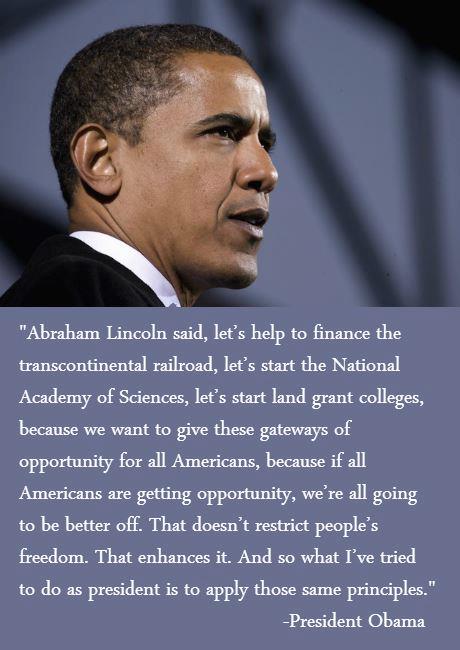
He is the President of the United States of America and the lack of respect he has been shown for his willingness to serve the people has been appalling and divisive.
History will not just judge him, but will also judge the people he has served.

Polling Conundrum

People who only have cell phones do not usually get hit by pollsters. Pollsters therefore “overweight” the results for the 18-30 year old bracket to offset the numbers. So do more Democrats (Ds) or more Republicans (Rs) only have cell phones?

Of course I hang up on all pollsters which makes me wonder, do more Ds hangup than Rs or more Rs than Ds?

Now wouldn’t these questions make for good news coverage. But wait, how would the data be collected since people like me don’t play along with all the polling?

Pondering National Prosperity and Security

I woke up this morning with an odd thought…

Are national educational issues, national health issues, national economic issues, and national security issues all intertwined?

Can we have one without the others?

A thing to ponder…


Trivia – prior to NSC 68, “National Prosperity and Security” was the vocabulary of politicians and not “National Security.”

Saith Me… King of the Hill

Does the enemy attack when we are weak? When we are distracted? Yes, historically there have been attacks when we have been weak and distracted. But we are also attacked when we are arrogantly standing on a hill declaring our greatness to the world.

So when did arrogance begin replacing weakness and distraction as the invitation for an attack? It happened after the First Gulf War, when the US people had shown they supported a fight. After that war, it became clear that the US public had changed since the Vietnam War. Kudos to President Reagan for reestablishing a fighting mentality in the people.

So why is arrogance and the willingness to fight an invitation for attack? In simple terms, the Cold War was a war of economic attrition with both sides betting that military spending would weaken the other side first. Enemies of the US took note, and knew that if the US was drawn into a protracted conflict, it would further weaken the US economy. If the US could be drawn into a preemptive or unilateral fight, then worldwide public opinion would also turn against and weaken the US.

This is the strategy of terrorism, peck at the king on the hill until he is overtaxed, spread too thin. Not so that victory can be achieved in a decisive battle, but so that the king will fall; fall from his own inability to stop reacting to the threat. Fall because rather than sharing the target on his back with allies, he will want to stand on the hill all alone. His arrogance will defeat his kingdom and not the enemy.

It isn’t a joking matter…

Presidents’ kids have a rough go of it, young or old, but the campaign family of the past was seen more than they were heard. If they could not advance the campaign, they stayed out of the campaign.

Tagg Romney’s comments go beyond “just being a son” and certainly beyond a “jest,” they play into the anger and frustration of a nation looking for someone to blame, to retaliate against for the suffering they feel. When we feel woe and strife, we tend to either hide or strike out. When the woe does not have a face attached, we look for a face to attach to it. This is the basic nature of the animal of man, to flee/hide or strike/attack. This campaign season highlights the very reality that man has not overcome his base instincts.

This is the nature of what Tagg Romney is expressing (even in jest), and the human nature he is pandering to in his comments. He has a right to “feel” and he has a right to “speak” but when he is part of the campaign, his feelings, if expressed, and his spoken words are part of the campaign. Bear in mind, Tagg Romney was born in 1970 and is old enough to run for president himself, so he is certainly accountable for the words he speaks, even under the pretense of a jest.

More importantly, Tagg Romney is part of his father’s circle and therefore his words are relevant to the campaign. A public representative, will be held accountable for their actions, and to some extent the actions of those in their circle.  After all the campaigning in which Mitt Romney has participated, he and his family should be aware that this is the reality.

I am disturbed that the Romney Clan has yet to understand this basic principle of campaign policy/strategy – what is spoken, joke, misspeak or open-mic, does matter to the public.  We see it as a peek inside the “real” person, whether it is or not.

The president, upon taking the oath of office, will no longer be the common man*, but will be held to a higher standard than the people he serves. The president does not need to be perfect, but he does need to understand the scrutiny will not ease up and the standards will always be high. If he, and his family, cannot handle this pressure in the campaign, they will implode when he is in the White House.  And that would not be a joking matter.

* or common woman

Tagg Romney’s apology