Simply joyful projects do more than just keep the hands busy, they cleanse and refuel the mind.
This week I have two simple flowers to share. They can either become decorative mini pillow ornaments, or they can be applied to a fabric square for use in a bigger project.
As I prepared for this post, I received a notification alerting me that today is the 12 year anniversary of my blog. It is fitting that the quilt block I am sharing today is called the Rolling Star because despite the chaos of life, my blog keeps rolling along.
Over the years, I have posted as the inspiration strikes rather than following any schedule or routine. Recently my posts tend to correspond with my vlog content, but every so often the pithy blog emerges from a meandering thought I feel is worth sharing.
Regardless the inspiration for my posts, I hope that they find their way to those who need to see them. For even if just one viewer finds value in the content, I feel the effort has been worthwhile. Of course, it goes without saying, the true value these last 12 years has been achieved in the record I have created.
Best wishes to all who read this blog post. Thank you for joining me as I roll along this meandering journey!
A classic block can shine in both vintage and modern fabrics. The Octagon Star is a great example of a classic eight pointed star set into a square for ease of piecing.
Remove the corners, and like the hexagon, the octagon opens up a world of possibilities.
Or keep it simple by setting the blocks in either a standard layout or on-point.
Pattern for the Octagon Star can be downloaded here.
Every so often a crafter will undertake a project that makes them ask, “What was I thinking?” In this week’s video, I share three of these projects – one of which is my English Paper Piecing block.
This is a block worth making, but it is also one that required a determination to get it to work rather than an expectation of perfection. I’m pretty sure that I was doomed from the moment the pieces were cut. This block required clear labels from start to finish – a step I neglected to do. I’m pretty sure a piece or two was flipped or mislabeled. However, despite being doomed from the beginning, I made it work. True, there was some tweaking and fudging during the construction, but the end result will still work for my project. The final quilt’s sashing should help hide any visible imperfections.
With all that being said, I still love the look of this star block and am glad I pressed on with it despite the foreboding I felt when I realized how finicky its construction would be. For more details on where I went wrong and how I made it work, I recommend watching this week’s vlog. It contains three “What was I thinking” projects and a good deal of me laughing at how much these projects spice up my life.
PDF Pattern for the Mountain Star block can be downloaded here
The new year has been full of fiber and fun. I have found my spinning, knitting, and crochet mojo again, but I am still embracing the joy of hand piecing quilt blocks. This block, while having been around for quite awhile, historically had no dominant name. So I named it in honor of the fireworks that fill the night sky on New Year’s Eve. It is a simple block, containing only four shapes (not counting the boarders). I hope it brings a sparkle to your patchwork project.
Star blocks are some of the most beloved designs in the patchwork quilt community. I’ve been drawn to them since my earliest days of patchwork. Foundation Paper Piecing and English Paper Piecing can bring precision and complexity to the process of getting sharply pointed stars. In the week’s to come, I will be sharing more stars, and even a compass. There will be a flower or two thrown in for good measure, but stars will dominate.
This week’s block is the seventeenth in my thirty block collection. Fittingly, for the season, it is known as the Bethlehem Star, named as such in 1938. It was also called the Star of the Magi in 1937.
In quilting, much like in life, the path we travel often lacks complexity; a routine can be followed that will keep us on course. Other times, we need help a map can offer. This week’s English Paper Piecing block, Morning Frost, reflects the complexity that has settled into my life this season. On the surface, it looks simple. Yet without the map guiding me, the subtle differences threatened to trip me up and make the task more difficult than necessary. Taking the time to make a map, or a set of steps to follow, preserved the easy and joy of the journey.
~~~~~~~~~~~~~~~~~~~~~~~~~~~~~
You can download this week’s block with this link.
When I made my first gingerbread doll, I used fabric from an old vest. Later I used hand-dyed wool to make the larger doll, and cream muslin for my tree topper. My first pattern was derived from a coloring page I had, then with time, it was modified a bit. Simple shapes like these are great places to begin ornament crafting. They can be sewn so that the raw edges are hidden inside the doll, or they could also be made using felt so that the raw edges could stay on the outside. Cookie cutters are a wonderful way to create the shapes for a whole host of ornaments similar to my little Ginger Doll.
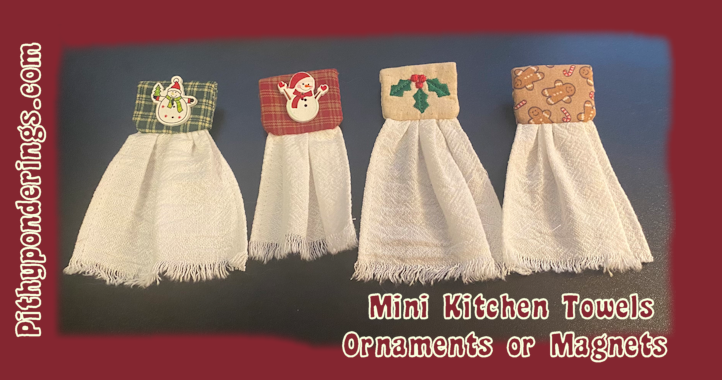
The idea to create a tiny kitchen towel came as I prepared for this week’s video. Christmas and baking go hand-in-hand, and I thought I could make more cookie cutter shapes. However since I have been making towel toppers this year to bring more festive fun into my kitchen, it seemed only natural that I should see if a miniature was possible. With a bit of experimentation, I was able to make my newest ornament. Yes, I will admit, I made my prototypes with my embroidery machine. It stitches so much more accurately than I do, but when I put the pattern together I found the traditional method of paper pattern and sewing machine easy and quick.
So this week, in addition to the English Paper Piecing block, I will share two more patterns with you.
A hexagon? A wagon wheel? A snow flake? A Christmas Wreath? Sometimes a simple shape can be the most confusing to name. This week’s English Paper Piecing block is an example of how the humble hexagon can be transformed simply by changing the fabric colors and placements.
~~~~~~~~~~~~~~~~~~~~~~~~~~~~~~~~~~~~
Pattern for this block with both the solid and segmented centers.
One of the first things a quilter learns when researching or designing a patchwork block is that color makes all the difference. Sometimes, the placement of light and dark fabric will change the overall look, and even the name of the block can be different because of the choices. In this week’s block, designing with three high contrast, warm colors created a star that was reminiscent of a yearly wheat harvest. Changing the fabric choices to a Christmas theme created a different look all-together. Since I am working on a vintage fabric quilt, I chose fabrics with less contrast, but still high impact because of the cream background. Whatever you choose, this pinwheel star is perfect for any season or palette.




 Pithy Ponderings